

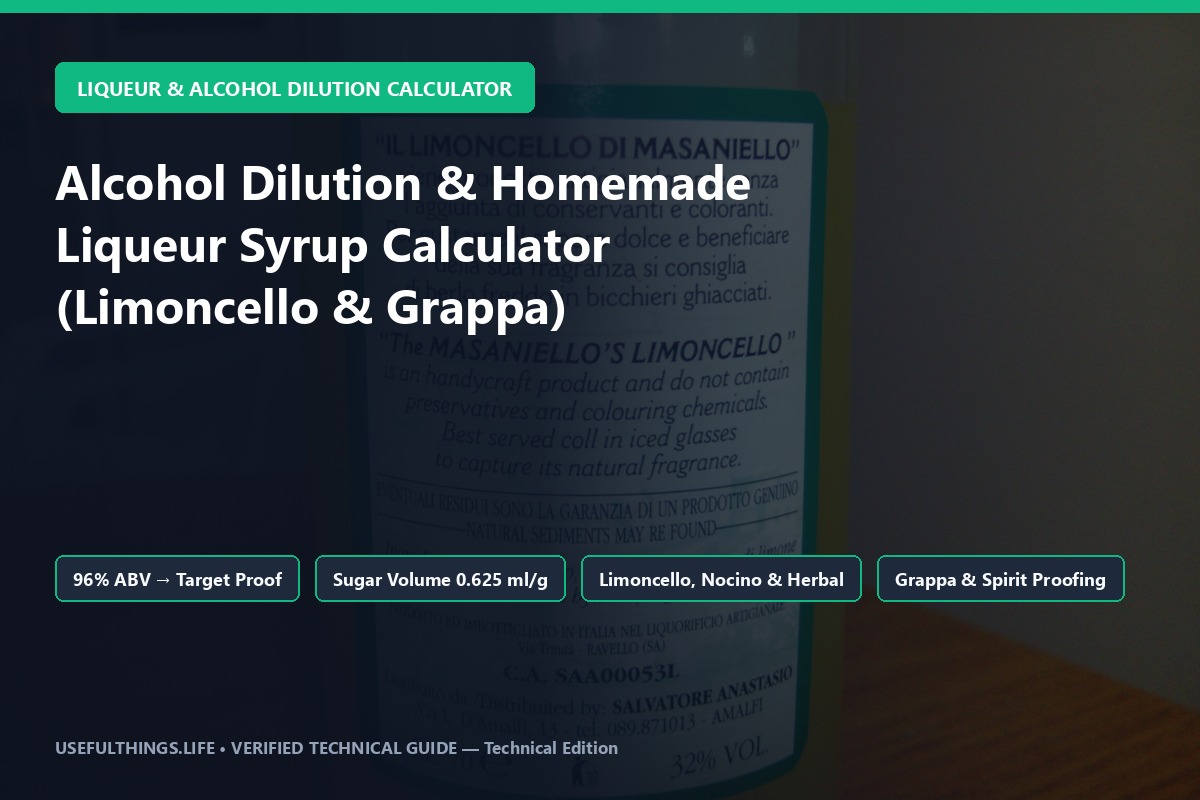
When crafting homemade limoncello, nocino, herbal bitters, or fruit infusions starting from 95%–96% ABV neutral grain spirit, or when proofing down a cask-strength distillate or grappa from 68%–75% ABV to a smooth 40%–42% ABV drinking strength, rough guesswork ruins the balance or causes the bottle to freeze solid in the freezer. True formulation accounts for two physical laws: 1 gram of dissolved sucrose displaces 0.625 ml of liquid volume, and mixing water with ethanol triggers a hydro-alcoholic volume contraction (~2.8%). Use our interactive dilution & syrup calculator below for exact milliliter and gram precision.
🍋 Interactive Alcohol Dilution & Homemade Liqueur Syrup Calculator
Gay-Lussac + Sugar Displacement
Quick Reference & Conversion Comparison Table
| # | Preparation / Parameter | Starting Spirit | Target ABV & Sugar % | Ratios per 1 Liter Starting Spirit |
|---|---|---|---|---|
| #1 | Gay-Lussac Formula for Proofing Pure Distillates Formula V2 = V1 × (ABV1 / ABV2) | Water = V1 × ((ABV1 – ABV2) / ABV2) | Contraction offset: +2.8% | Zero added sugar |
| #2 | Dissolved Sugar Volume Displacement in Syrup (×0.625 ml/g) 1 kg Sugar = 625 ml | 100 g sugar = +62.5 ml volume | 1000 g sugar = +625 ml volume | Prevents over-dilution |
| #3 | Freezer-Safe Homemade Limoncello Ratio (30%–32% ABV) 1L 96% ➔ 3.2L at 30% | Zest: 10 organic lemons (yellow only) | Syrup: 1655 ml water + 896 g sugar | Freezing point: -21°C (-6°F) |
| #4 | Herbal Amaro, Nocino, Myrtle & Coffee Liqueurs (28%–30% ABV) 25%–30% Sugar | Herbal Amaro: 30% ABV / 22% sugar | Nocino/Berry: 30% ABV / 28% sugar | Coffee Liqueur: 26% ABV / 32% sugar |
| #5 | Choosing the Right Water (Distilled or Low-Mineral Spring Water) TDS < 50 mg/L | Never use hard tap water | Dry residue (TDS) < 50 mg/L | Prevents cloudy precipitation |
| #6 | Why Syrup Must Cool to Room Temperature (20°C) Before Mixing Anti-Haze Rule | Cool syrup to 20°C (68°F) | Ethanol boils at 78.3°C | Protects volatile citrus oils |
| #7 | The Louche Effect (Natural Essential Oil Micro-Emulsion) Terpene Emulsion | Seen in Limoncello, Pastis, Ouzo | Terpenes emulsify below 45% ABV | Proof of real citrus oils |
| #8 | Alcoholmeter Hydrometer Temperature Correction (20°C Standard) ±0.35% ABV per °C | Standard calibration: 20°C (68°F) | At 10°C reads ~3.5% too low | At 30°C reads ~3.5% too high |
| #9 | Cream Liqueurs: Crema di Limoncello & Chocolate Cream (17%–21% ABV) 17%–21% ABV | Cream liqueur target: 17%–21% ABV | Whole milk + Heavy cream base | Store in freezer |
| #10 | Bottle Marriage & Resting Period (30 Days in the Dark) Ester Harmonization | Minimum rest: 20–30 days | Dark glass or cool cupboard | Rounds out ethanol bite |

Detailed Technical Guide: Top 10 Practical Cases & Factors
#1 Gay-Lussac Formula for Proofing Pure Distillates Formula V2 = V1 × (ABV1 / ABV2)
To proof down an unsweetened distillate or grappa from ABV1 (e.g., 68%) to ABV2 (e.g., 42%), theoretical water is V1 × (68 – 42) / 42 = 619 ml per liter, rising to 636 ml once hydrogen-bonding volume contraction between ethanol and water is compensated.
✅ Key Takeaways & Practical Advantages
- Milliliter accuracy for small craft batches
- Automatically accounts for real-world ethanol-water contraction
⚠️ Common Mistakes to Avoid
- Always read your glass alcoholmeter hydrometer at exactly 20°C (68°F)
#2 Dissolved Sugar Volume Displacement in Syrup (×0.625 ml/g) 1 kg Sugar = 625 ml
When you dissolve 1000 g of white sugar in 1000 ml of water, you do not get 1000 ml of syrup — you get 1625 ml! Ignoring sugar displacement adds too much water, dropping your limoncello to 24% ABV so it freezes solid in the freezer.
✅ Key Takeaways & Practical Advantages
- Our calculator automatically subtracts sugar volume from the water required
- Hits your target ABV accurately without trial and error
⚠️ Common Mistakes to Avoid
- Floating alcoholmeters cannot read sweetened liqueurs because dissolved sugar raises liquid density
#3 Freezer-Safe Homemade Limoncello Ratio (30%–32% ABV) 1L 96% ➔ 3.2L at 30%
Home freezers run at -18°C (0°F). Because a 25% ABV liqueur freezes at -14°C while a 30%–32% ABV liqueur stays liquid down to -21°C, formulating limoncello at 30%–32% ABV with 28% sugar guarantees a velvety pour straight from the freezer.
✅ Key Takeaways & Practical Advantages
- Never freezes solid inside a -18°C home freezer
- Extracts bright essential oils from lemon zest in 7–10 days in the dark
⚠️ Common Mistakes to Avoid
- Peel only the outer yellow zest (flavedo) with a microplane/peeler, zero bitter white pith
#4 Herbal Amaro, Nocino, Myrtle & Coffee Liqueurs (28%–30% ABV) 25%–30% Sugar
Digestif herbal bitters (gentian, rosemary, bay leaf, artichoke) shine at lower sweetness (20%–24% sugar at 30%–32% ABV), whereas coffee or licorice liqueurs benefit from richer body (30%–32% sugar at 25%–27% ABV).
✅ Key Takeaways & Practical Advantages
- Dial in your exact sweetness level while locking in target ABV
⚠️ Common Mistakes to Avoid
- Filter through unbleached paper coffee filters before bottling to remove sediment
#5 Choosing the Right Water (Distilled or Low-Mineral Spring Water) TDS < 50 mg/L
Diluting high-proof spirits with hard tap water causes calcium and magnesium salts to precipitate in ethanol, turning clear grappa permanently cloudy. Always use food-grade distilled water or low-mineral spring water (< 50 mg/L TDS).
✅ Key Takeaways & Practical Advantages
- Keeps clear spirits crystal bright even when chilled
⚠️ Common Mistakes to Avoid
- Always cool simple syrup completely to 20°C before mixing with infused alcohol

#6 Why Syrup Must Cool to Room Temperature (20°C) Before Mixing Anti-Haze Rule
Ethanol boils at 78.3°C (173°F): pouring piping-hot sugar syrup into infused alcohol flashes off alcohol vapor, cooks delicate citrus essential oils, and triggers thermal shock haze.
✅ Key Takeaways & Practical Advantages
- Preserves vibrant, fresh-picked citrus aroma
- Prevents losing 2–3% ABV to steam evaporation
⚠️ Common Mistakes to Avoid
- Let boiled simple syrup cool for 45–60 minutes before combining
#7 The Louche Effect (Natural Essential Oil Micro-Emulsion) Terpene Emulsion
In limoncello and anise spirits, dropping the ABV below 45% causes hydrophobic essential oils (limonene, anethole) to form astable, milky-yellow micro-emulsion known as the Louche effect — the hallmark of real botanical oils!
✅ Key Takeaways & Practical Advantages
- Confirms high natural essential oil extraction from real fruit zest
⚠️ Common Mistakes to Avoid
- In clear grappa proofed below 42% ABV, chill-filter through paper at 0°C to remove fatty esters
#8 Alcoholmeter Hydrometer Temperature Correction (20°C Standard) ±0.35% ABV per °C
Glass alcoholmeters are calibrated at 20°C (68°F). Testing spirit in a cold 10°C cellar makes the liquid denser so the hydrometer reads ~3.5% ABV lower than reality; at 30°C it reads ~3.5% higher.
✅ Key Takeaways & Practical Advantages
- Warm or cool your test jar to 20°C, or apply ±0.35% ABV per degree °C offset
⚠️ Common Mistakes to Avoid
- Choose a thermo-alcoholmeter with a built-in thermometer strip
#9 Cream Liqueurs: Crema di Limoncello & Chocolate Cream (17%–21% ABV) 17%–21% ABV
For dairy-based cream liqueurs (Crema di Limoncello, Pistachio, or Gianduia Cream), replace water with whole milk and cream scalded with sugar, targeting a gentle 17%–21% final ABV.
✅ Key Takeaways & Practical Advantages
- Rich, velvety dessert texture
- Alcohol preserves the dairy emulsion in the freezer for 4–6 months
⚠️ Common Mistakes to Avoid
- Keep final ABV below 22%–24% or high ethanol concentration will curdle milk casein proteins
#10 Bottle Marriage & Resting Period (30 Days in the Dark) Ester Harmonization
Right after blending infused spirit and syrup, ethanol, water, and sucrose molecules are not yet fully bound, leaving a sharp alcohol burn on the palate. Resting the bottle for 3–4 weeks allows hydrogen bonds to stabilize into a smooth finish.
✅ Key Takeaways & Practical Advantages
- Eliminates harsh raw-alcohol heat naturally
⚠️ Common Mistakes to Avoid
- Keep bottles away from sunlight, which oxidizes green herbal chlorophyll and citrus terpenes





Leave a Reply