

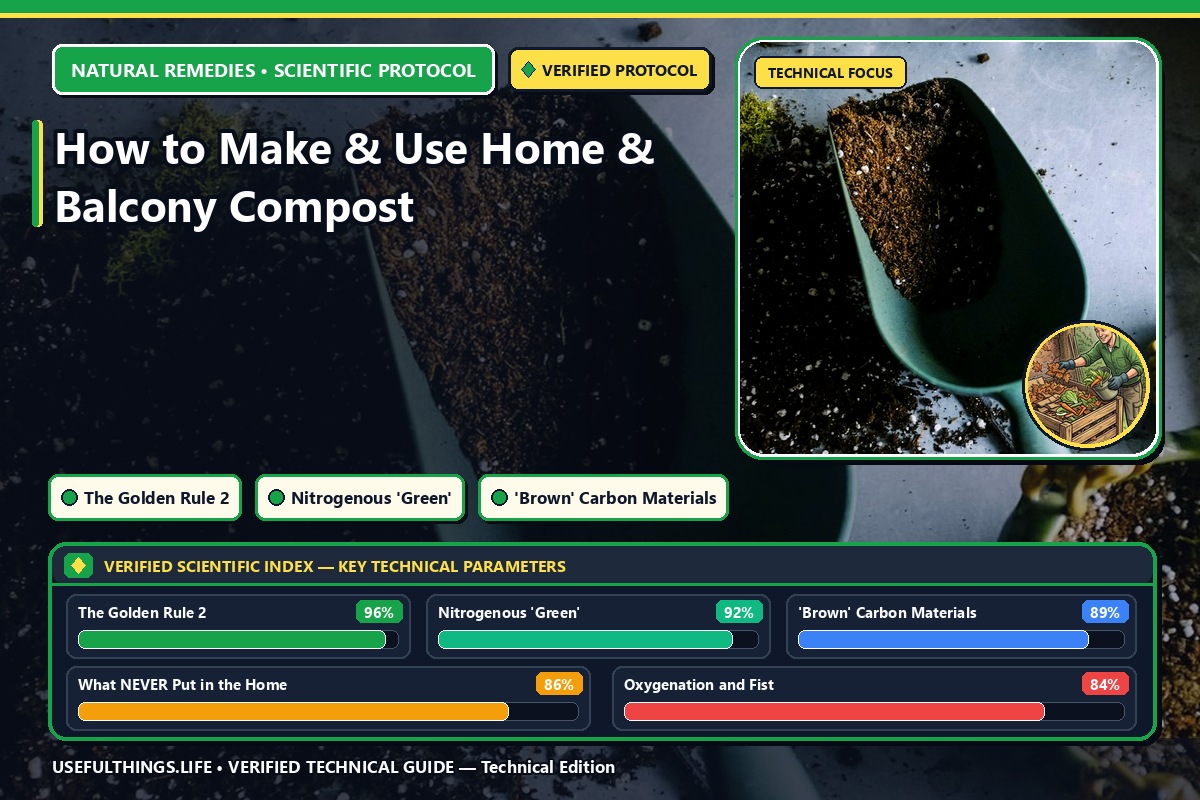
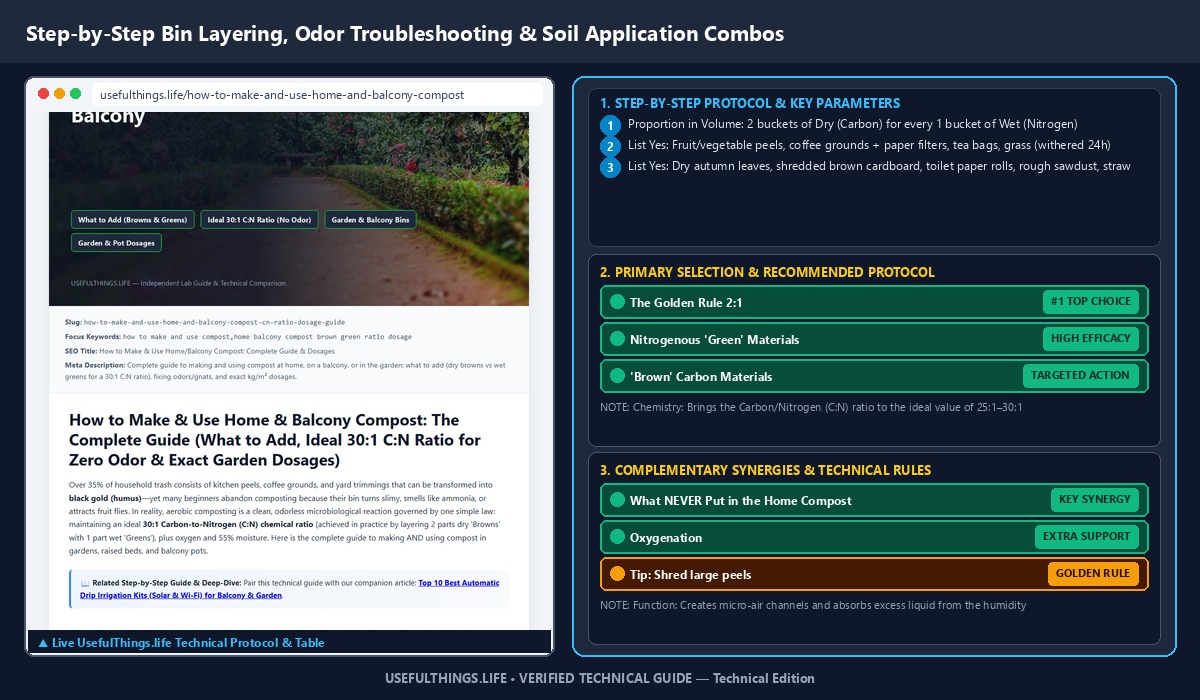
Over 35% of household trash consists of kitchen peels, coffee grounds, and yard trimmings that can be transformed into black gold (humus)—yet many beginners abandon composting because their bin turns slimy, smells like ammonia, or attracts fruit flies. In reality, aerobic composting is a clean, odorless microbiological reaction governed by one simple law: maintaining an ideal 30:1 Carbon-to-Nitrogen (C:N) chemical ratio (achieved in practice by layering 2 parts dry ‘Browns’ with 1 part wet ‘Greens’), plus oxygen and 55% moisture. Here is the complete guide to making AND using compost in gardens, raised beds, and balcony pots.
Step-by-Step Bin Layering, Odor Troubleshooting & Soil Application Combos
Follow the visual guide below to layer your compost bin properly and apply the exact amount of finished compost to your vegetable beds, fruit trees, and balcony planters.
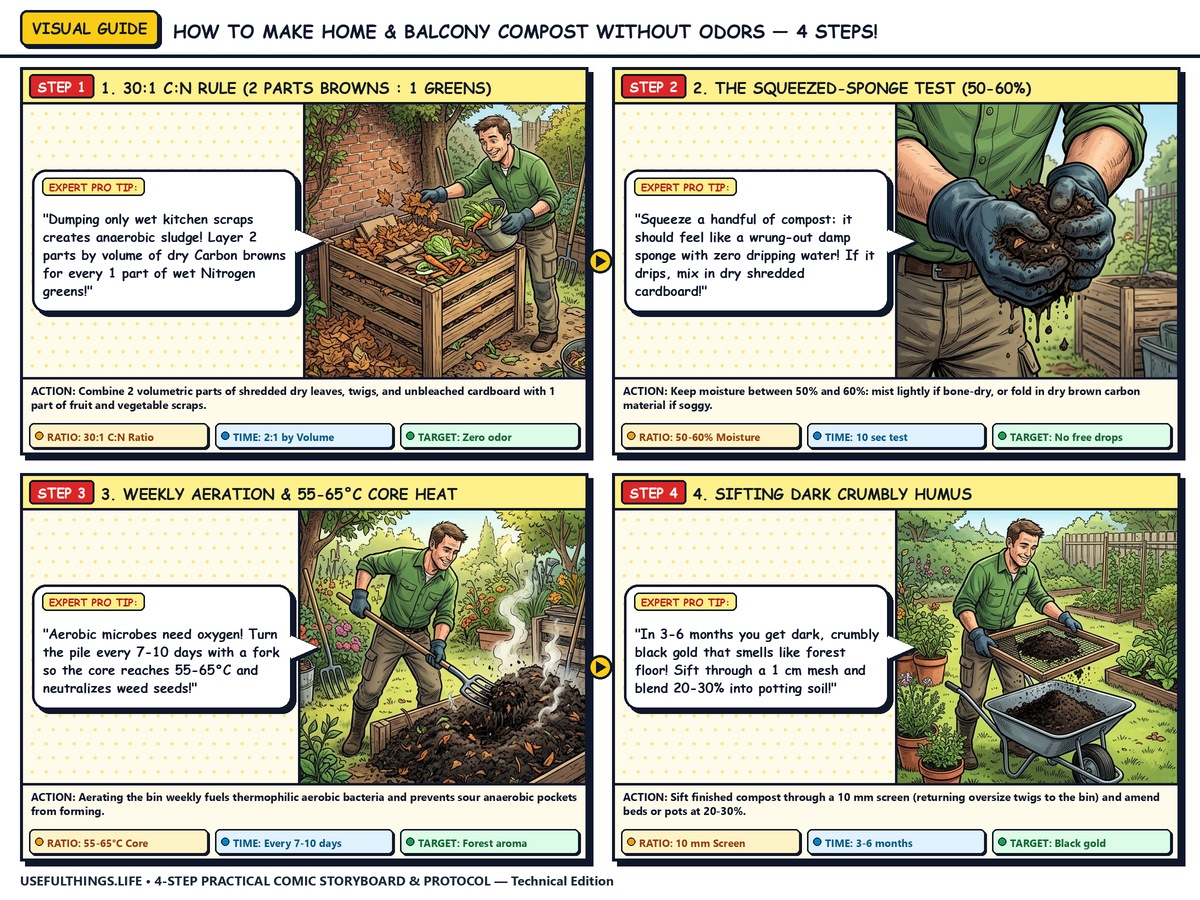
Step-by-Step Practical Comic Storyboard (4 Key Phases)
Quick Comparison & Reference Table: How To Make And Use Compost at a Glance
| # | Section / Step / System | Best For / Role | Navigation / Key Spec 1 | Combo / Key Spec 2 |
|---|---|---|---|---|
| #1 | The Golden Rule 2:1 (2 Parts Brown Dry + 1 Part Green Wet) | The #1 Law for Zero Odor, Zero Flies & Fast Humus | Proportion in Volume: 2 buckets of Dry (Carbon) for every 1 bucket of Wet (Nitrogen) | Chemistry: Brings the Carbon/Nitrogen (C:N) ratio to the ideal value of 25:1–30:1 |
| #2 | Nitrogenous ‘Green’ Materials (What to Put: Kitchen Scraps, Coffee, Tea, Grass) | The Nitrogen Activator That Heats Up the Compost Pile | List Yes: Fruit/vegetable peels, coffee grounds + paper filters, tea bags, grass (withered 24h) | Tip: Shred large peels (watermelon, cores, cabbage stems) to 3–4 cm |
| #3 | ‘Brown’ Carbon Materials (Dry Leaves, Non-Plasticized Cardboard, Twigs) | The Structural Sponge That Provides Oxygen & Humic Acids | List Yes: Dry autumn leaves, shredded brown cardboard, toilet paper rolls, rough sawdust, straw | Function: Creates micro-air channels and absorbs excess liquid from the humidity |
| #4 | What NEVER Put in the Home Compost (The Black List) | Essential Safety Rules to Avoid Pathogens, Rats & Toxins | Prohibited: Meat/fish/bones, dairy products/fats, dog/cat litter, diseased plants, weeds with seeds, painted wood, coated paper | Exception: Citrus fruits and onions: Yes but in moderation (<10%) and well chopped |
| #5 | Oxygenation (Turnover every 2–3 Weeks) and Fist Moisture Test | Best Technique to Cut Maturation Time From 12 Months to 4 Months | Control: Turn with a pitchfork or spiral aerator every 15–20 days | Fist Test: Squeezing a handful should feel like a well-wrung sponge (0 drops) |
| #6 | Free Natural Accelerators (Nettle Macerate, Forest Earth, Coffee Grounds) | Best Zero-Cost Microbial Starters (Skip Commercial Powders!) | Dose: 2 handfuls of forest/garden soil + 1 watering of nettle macerate or expired beer | Action: Inoculates billions of bacteria, actinomycetes and native decomposing fungi |
| #7 | Balcony composting: Worm composter (Vermicompost) and Bokashi | Best Odorless Solutions for Apartments & Small Terraces | Earthworm composter: Californian red earthworms (Eisenia fetida) in stackable boxes | Bokashi: Hermetic anaerobic fermentation in 14 days with EM bran (also citrus and cooked!) |
| #8 | How to Recognize Between Fresh Compost (3–4 Months) and Mature Compost (8–12 Months) | Crucial Test Before Applying Compost to Seeds or Roots | Fresh Compost (3-4 months): Still seeing bits and worms → use ONLY as mulch | Mature Compost (8-12 months): Black, homogeneous, cold, forest scent → sieve at 10 mm |
| #9 | Exact Doses in the Vegetable Garden for Crops (Voracious: 4 kg/m² vs Medium: 2 kg/m²) | Scientific Application Table for Tomatoes, Potatoes, Lettuce & Beans | Voracious Vegetables (Tomatoes, Courgettes, Cabbages, Potatoes, Pumpkin): 3.5 – 5 kg/m² (1 bucket every 2 m²) | Medium/Low Vegetables (Salads, Carrots, Onions, Beans, Herbs): 1 – 2 kg/m² |
| #10 | How to Use Compost in Balcony Pots, Fruit Trees and Lawn (Top-Dressing) | Best Ratio for Potting Soil Renewal (20–30%) & Tree Rings | Pots and Planters: 25% sifted mature compost + 65% Soil + 10% Perlite/Pumice | Fruit Trees and Roses: 3–5 cm below the canopy projection | Lawn: 1 L/m² fine sifted |
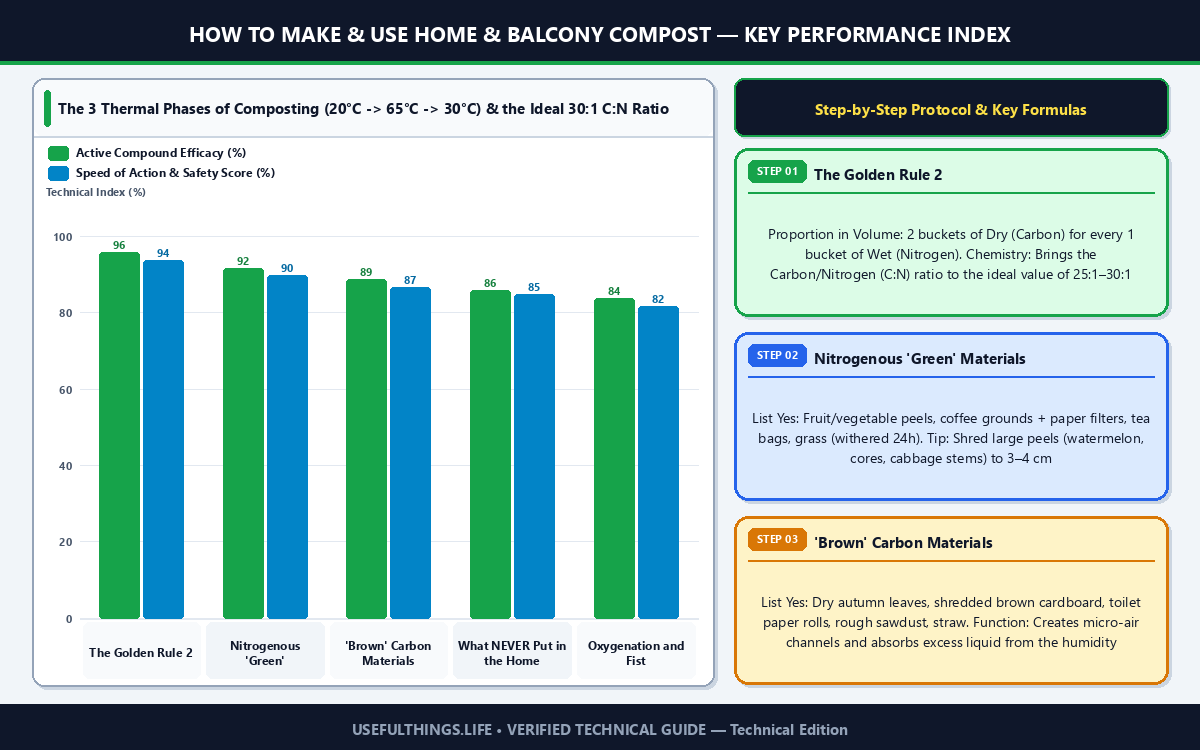
The 3 Thermal Phases of Composting (20°C -> 65°C -> 30°C) & the Ideal 30:1 C:N Ratio
Look at our thermal curve chart below: aerobic bacteria need roughly 30 parts Carbon for every 1 part Nitrogen (C:N = 30:1). Because kitchen scraps are very rich in nitrogen (C:N ~15:1) and dry leaves/cardboard are very rich in carbon (C:N ~60:1 to 200:1), you reach the 30:1 chemical sweet spot simply by alternating 2 buckets of dry Brown material with 1 bucket of wet Green scraps.
Real-World Visual Inspection & Key Details (How To Make And Use Compost)
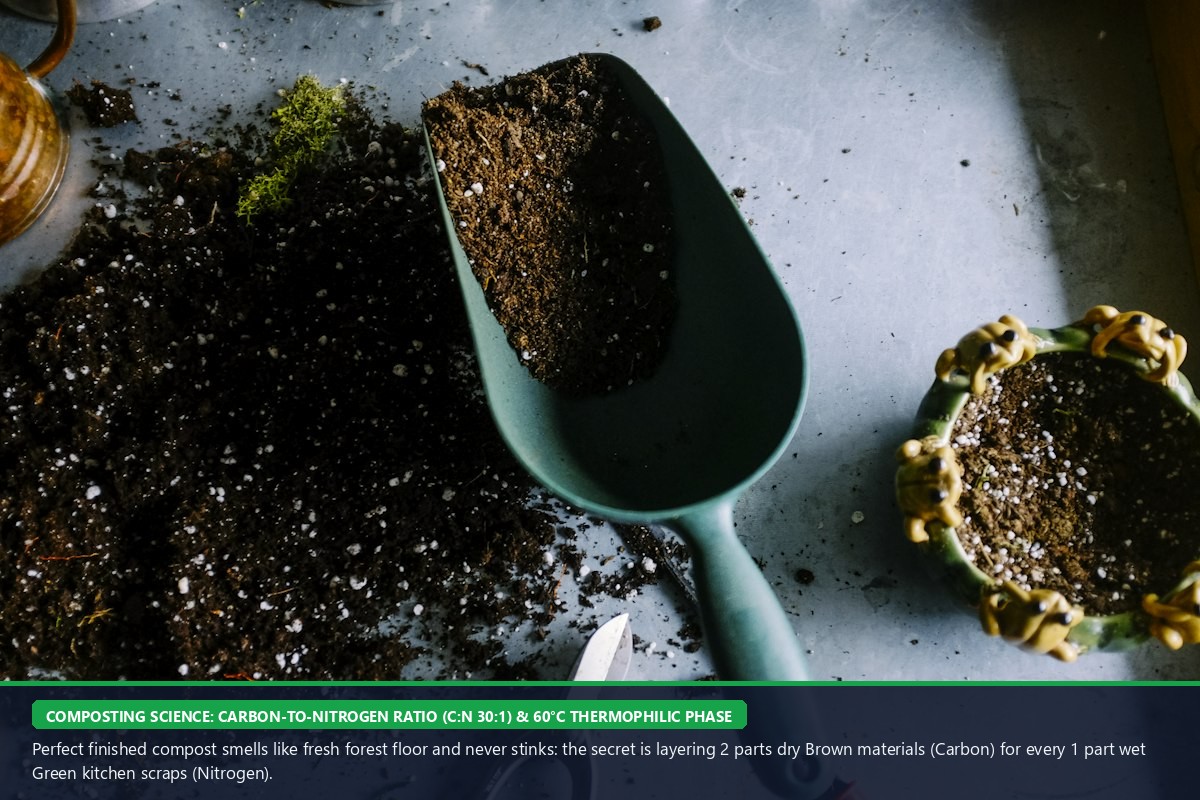
Perfect finished compost smells like fresh forest floor and never stinks: the secret is layering 2 parts dry Brown materials (Carbon) for every 1 part wet Green kitchen scraps (Nitrogen).
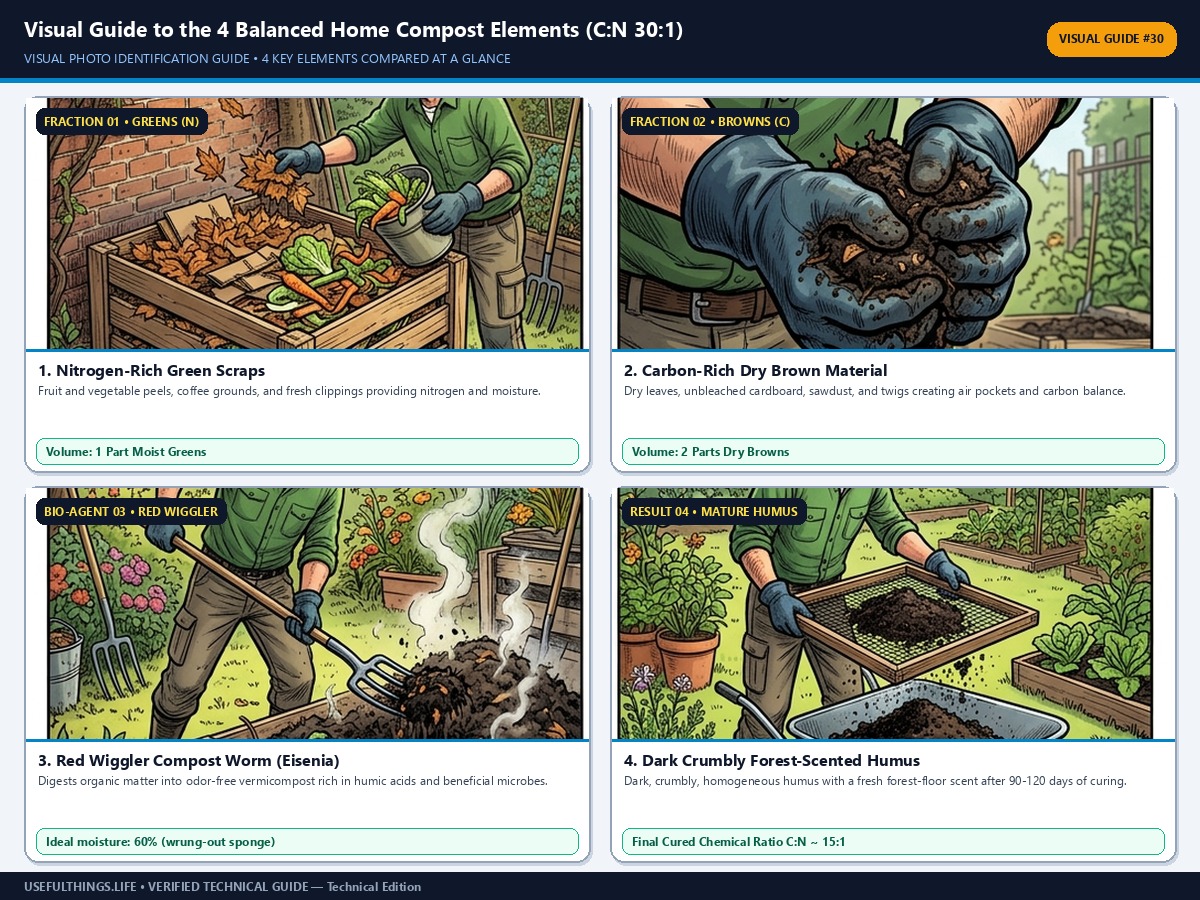
Visual Guide to the 4 Balanced Home Compost Elements (C:N 30:1)
In the photographic identification board and the 4 reference cards below, compare at a glance the 4 key visual targets covered in this guide so you can recognize them immediately:
Complete 10-Point Breakdown & Step-by-Step Analysis: How To Make And Use Compost
#1 The Golden Rule 2:1 (2 Parts Brown Dry + 1 Part Green Wet) The #1 Law for Zero Odor, Zero Flies & Fast Humus
In position #1 of our how to make and use compost analysis, The Golden Rule 2:1 (2 Parts Brown Dry + 1 Part Green Wet) stands out by combining Proportion in Volume: 2 buckets of Dry (Carbon) for every 1 bucket of Wet (Nitrogen), Chemistry: Brings the Carbon/Nitrogen (C:N) ratio to the ideal value of 25:1–30:1, and Guarantees Sweet Forest-Floor Aroma & Rapid Decomposition. Highlighted as The #1 Law for Zero Odor, Zero Flies & Fast Humus, it provides a decisive technical benchmark.
Kitchen scraps have a C:N ratio of 15:1 (too much nitrogen and water), while dry leaves and cardboard are 60:1 to 300:1; layering 2 parts Brown over every 1 part Green creates the exact 30:1 balance aerobic bacteria need
Always bury fresh fruit/vegetable peels under a 5 cm blanket of dry leaves or shredded brown cardboard so fruit flies cannot reach them
#2 Nitrogenous ‘Green’ Materials (What to Put: Kitchen Scraps, Coffee, Tea, Grass) The Nitrogen Activator That Heats Up the Compost Pile
In position #2 of our how to make and use compost analysis, Nitrogenous ‘Green’ Materials (What to Put: Kitchen Scraps, Coffee, Tea, Grass) stands out by combining List Yes: Fruit/vegetable peels, coffee grounds + paper filters, tea bags, grass (withered 24h), Tip: Shred large peels (watermelon, cores, cabbage stems) to 3–4 cm, and Feeds Thermophilic Bacteria to Reach 55–65°C Inside the Core. Highlighted as The Nitrogen Activator That Heats Up the Compost Pile, it provides a decisive technical benchmark.
Green materials provide the protein, nitrogen, and moisture that fuel rapid bacterial multiplication during the first 2 to 4 weeks
Never dump a thick 20 cm layer of fresh wet lawn clippings all at once (it mats into an airless layer)—let grass wilt for 24h and mix 50/50 with dry leaves!
#3 ‘Brown’ Carbon Materials (Dry Leaves, Non-Plasticized Cardboard, Twigs) The Structural Sponge That Provides Oxygen & Humic Acids
In position #3 of our how to make and use compost analysis, ‘Brown’ Carbon Materials (Dry Leaves, Non-Plasticized Cardboard, Twigs) stands out by combining List Yes: Dry autumn leaves, shredded brown cardboard, toilet paper rolls, rough sawdust, straw, Function: Creates micro-air channels and absorbs excess liquid from the humidity, and Prevents Anaerobic Putrefaction & Builds Long-Lasting Soil Humus. Highlighted as The Structural Sponge That Provides Oxygen & Humic Acids, it provides a decisive technical benchmark.
Woody/fibrous brown materials rich in lignin and cellulose keep the pile fluffy so oxygen reaches the center, while fungi convert their lignin into stable dark humic acids
Remove plastic tape and staples from brown shipping boxes before tearing them into 5cm strips
#4 What NEVER Put in the Home Compost (The Black List) Essential Safety Rules to Avoid Pathogens, Rats & Toxins
In position #4 of our how to make and use compost analysis, What NEVER Put in the Home Compost (The Black List) stands out by combining Prohibited: Meat/fish/bones, dairy products/fats, dog/cat litter, diseased plants, weeds with seeds, painted wood, coated paper, Exception: Citrus fruits and onions: Yes but in moderation (<10%) and well chopped, and Keeps Your Compost 100% Hygienic & Safe for Vegetable Crops. Highlighted as Essential Safety Rules to Avoid Pathogens, Rats & Toxins, it provides a decisive technical benchmark.
Meat, fish, dairy, and cooked oils putrefy and attract rodents; dog/cat feces carry parasites; and perennial weed roots (bindweed, couch grass) or seeded weeds can survive if the edges of the bin don’t reach 60°C
Coal/charcoal ash is toxic (heavy metals)—use only small amounts of pure, untreated fireplace wood ash
#5 Oxygenation (Turnover every 2–3 Weeks) and Fist Moisture Test Best Technique to Cut Maturation Time From 12 Months to 4 Months
In position #5 of our how to make and use compost analysis, Oxygenation (Turnover every 2–3 Weeks) and Fist Moisture Test stands out by combining Control: Turn with a pitchfork or spiral aerator every 15–20 days, Fist Test: Squeezing a handful should feel like a well-wrung sponge (0 drops), and Prevents Rotten-Egg/Ammonia Smells & Accelerates Breakdown. Highlighted as Best Technique to Cut Maturation Time From 12 Months to 4 Months, it provides a decisive technical benchmark.
Aerobic microbes breathe oxygen just like we do: turning the pile brings outer layers into the hot center and restores oxygen; if it’s bone-dry, sprinkle water; if it drips when squeezed, mix in dry cardboard
In summer, place the compost bin in partial shade (under a deciduous tree) so it doesn’t bake dry
#6 Free Natural Accelerators (Nettle Macerate, Forest Earth, Coffee Grounds) Best Zero-Cost Microbial Starters (Skip Commercial Powders!)
In position #6 of our how to make and use compost analysis, Free Natural Accelerators (Nettle Macerate, Forest Earth, Coffee Grounds) stands out by combining Dose: 2 handfuls of forest/garden soil + 1 watering of nettle macerate or expired beer, Action: Inoculates billions of bacteria, actinomycetes and native decomposing fungi, and Kickstarts Cold Winter or Newly Started Compost Bins. Highlighted as Best Zero-Cost Microbial Starters (Skip Commercial Powders!), it provides a decisive technical benchmark.
You never need to buy commercial ‘compost accelerator’ boxes: two handfuls of healthy garden soil or old compost plus nettle tea or coffee grounds provide all the native microbes and nitrogen needed
Crushed eggshells also buffer excess organic acids during the initial fermentation week
#7 Balcony composting: Worm composter (Vermicompost) and Bokashi Best Odorless Solutions for Apartments & Small Terraces
In position #7 of our how to make and use compost analysis, Balcony composting: Worm composter (Vermicompost) and Bokashi stands out by combining Earthworm composter: Californian red earthworms (Eisenia fetida) in stackable boxes, Bokashi: Hermetic anaerobic fermentation in 14 days with EM bran (also citrus and cooked!), and Produces Ultra-Rich Worm Castings & Liquid Fertilizer on a Balcony. Highlighted as Best Odorless Solutions for Apartments & Small Terraces, it provides a decisive technical benchmark.
For a shaded balcony (10–28°C), a 3-tray worm bin with Eisenia fetida worms turns kitchen scraps into odorless worm castings (5x richer in NPK than garden soil); for indoor kitchens, an airtight Bokashi bucket ferments scraps in 2 weeks
Dilute the liquid tea (‘percolato’) drained from a worm bin or Bokashi tap 1:10 to 1:20 with water before watering plants!
#8 How to Recognize Between Fresh Compost (3–4 Months) and Mature Compost (8–12 Months) Crucial Test Before Applying Compost to Seeds or Roots
In position #8 of our how to make and use compost analysis, How to Recognize Between Fresh Compost (3–4 Months) and Mature Compost (8–12 Months) stands out by combining Fresh Compost (3-4 months): Still seeing bits and worms → use ONLY as mulch, Mature Compost (8-12 months): Black, homogeneous, cold, forest scent → sieve at 10 mm, and Prevents ‘Nitrogen Robbery’ & Phytotoxicity on Young Seedlings. Highlighted as Crucial Test Before Applying Compost to Seeds or Roots, it provides a decisive technical benchmark.
Immature compost is still decomposing and temporarily steals nitrogen from soil (‘fame d’azoto’) while releasing organic acids that inhibit seed germination; mature compost is cool, dark, and passes the 72-hour cress seed germination test
Use a 1 cm mesh crate or garden riddle to sift mature compost; toss any coarse uncomposted twigs back into the bin as a starter!
#9 Exact Doses in the Vegetable Garden for Crops (Voracious: 4 kg/m² vs Medium: 2 kg/m²) Scientific Application Table for Tomatoes, Potatoes, Lettuce & Beans
In position #9 of our how to make and use compost analysis, Exact Doses in the Vegetable Garden for Crops (Voracious: 4 kg/m² vs Medium: 2 kg/m²) stands out by combining Voracious Vegetables (Tomatoes, Courgettes, Cabbages, Potatoes, Pumpkin): 3.5 – 5 kg/m² (1 bucket every 2 m²), Medium/Low Vegetables (Salads, Carrots, Onions, Beans, Herbs): 1 – 2 kg/m², and Maximizes Yield Without Nitrate Accumulation or Root Rot. Highlighted as Scientific Application Table for Tomatoes, Potatoes, Lettuce & Beans, it provides a decisive technical benchmark.
Never bury compost 30 cm deep where aerobic microbes suffocate: incorporate it lightly into the top 5 to 10 cm of soil with a rake or hoe 2–3 weeks before transplanting
Root crops (carrots, radishes, garlic, onions) dislike fresh or heavy compost—give them only 1 kg/m² of very mature sifted compost!
#10 How to Use Compost in Balcony Pots, Fruit Trees and Lawn (Top-Dressing) Best Ratio for Potting Soil Renewal (20–30%) & Tree Rings
In position #10 of our how to make and use compost analysis, How to Use Compost in Balcony Pots, Fruit Trees and Lawn (Top-Dressing) stands out by combining Pots and Planters: 25% sifted mature compost + 65% Soil + 10% Perlite/Pumice, Fruit Trees and Roses: 3–5 cm below the canopy projection | Lawn: 1 L/m² fine sifted, and Revives Exhausted Balcony Potting Soil Without Buying New Bags Every Year. Highlighted as Best Ratio for Potting Soil Renewal (20–30%) & Tree Rings, it provides a decisive technical benchmark.
Instead of throwing away old balcony potting soil each spring, remove the top 5 cm of roots, mix in 25% sifted mature compost, and your soil is richer and more water-retentive than store-bought bags
On fruit trees, spread compost in a ring under the outer drip-line of the branches (never piled against the bark of the trunk!)
Frequently Asked Questions (FAQ) on How To Make And Use Compost
What is the most important rule to remember about how to make and use compost?
When dealing with how to make and use compost and home balcony compost brown green ratio dosage, always verify the exact selection combo or temperature/grading parameter shown in our step-by-step chart above before finalizing your choice.
How do the selection combos change the real-world outcome?
Selecting the recommended green-tier options in our How to Layer Your Compost Bin (2 Parts Brown + 1 Green) & Dosage Combos walkthrough avoids the most common hidden pitfalls while maximizing reliability, warranty coverage, or culinary authenticity.





Leave a Reply