

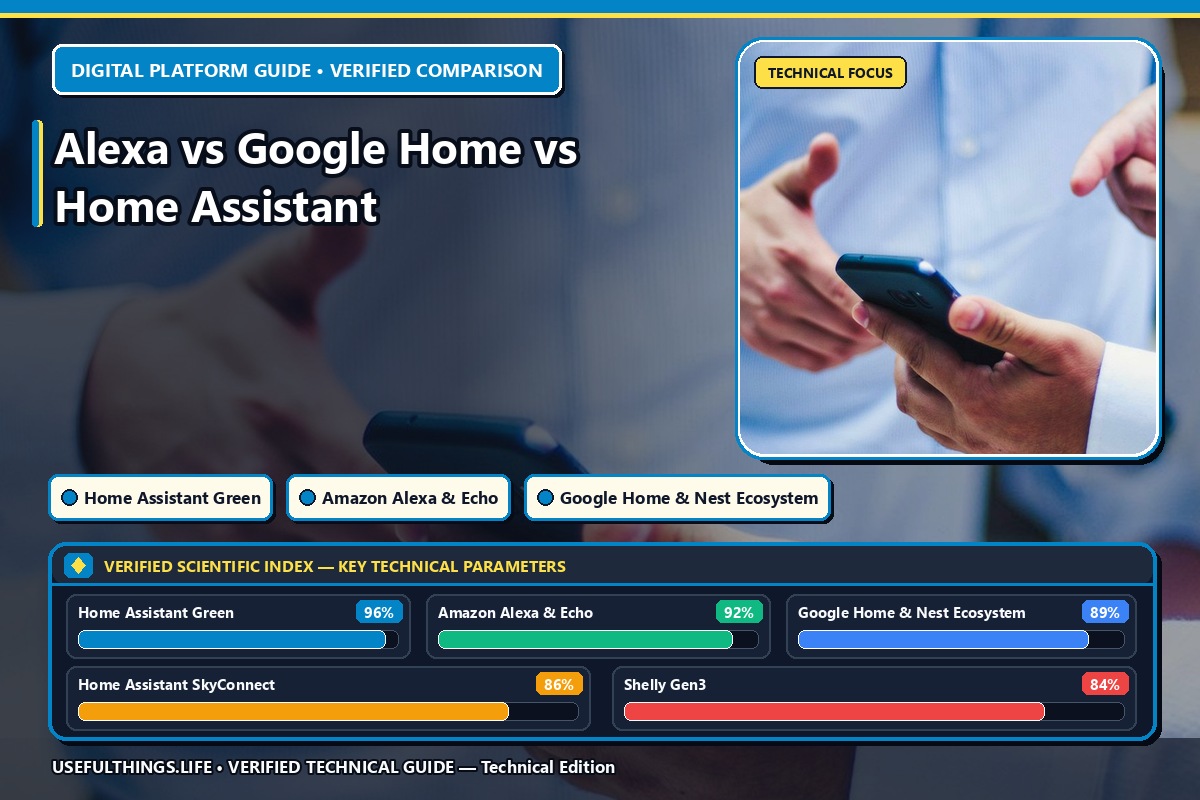
Anyone building a modern smart home eventually hits the same wall: you start with a smart plug and a voice speaker, and six months later your phone is cluttered with 7 different manufacturer apps (Tuya, Shelly, Philips Hue, Tapo, Ikea, Aqara, Meross) that stop talking to each other whenever your Wi-Fi hiccups. Choosing between Amazon Alexa, Google Home, and Home Assistant—or combining them into a hybrid local + voice stack—is the single most important architectural decision for your home.
Visual Guide: How Automation Combos Work (Alexa/Google Routines vs Home Assistant Trigger-Condition-Action)
Look at our annotated comparison below to see how you navigate to the automation builder in each platform and why Home Assistant’s 3-block Combo (When Trigger → And If Condition → Then Do Action) unlocks energy-saving solar, heating, and security logic that cloud apps simply cannot express.
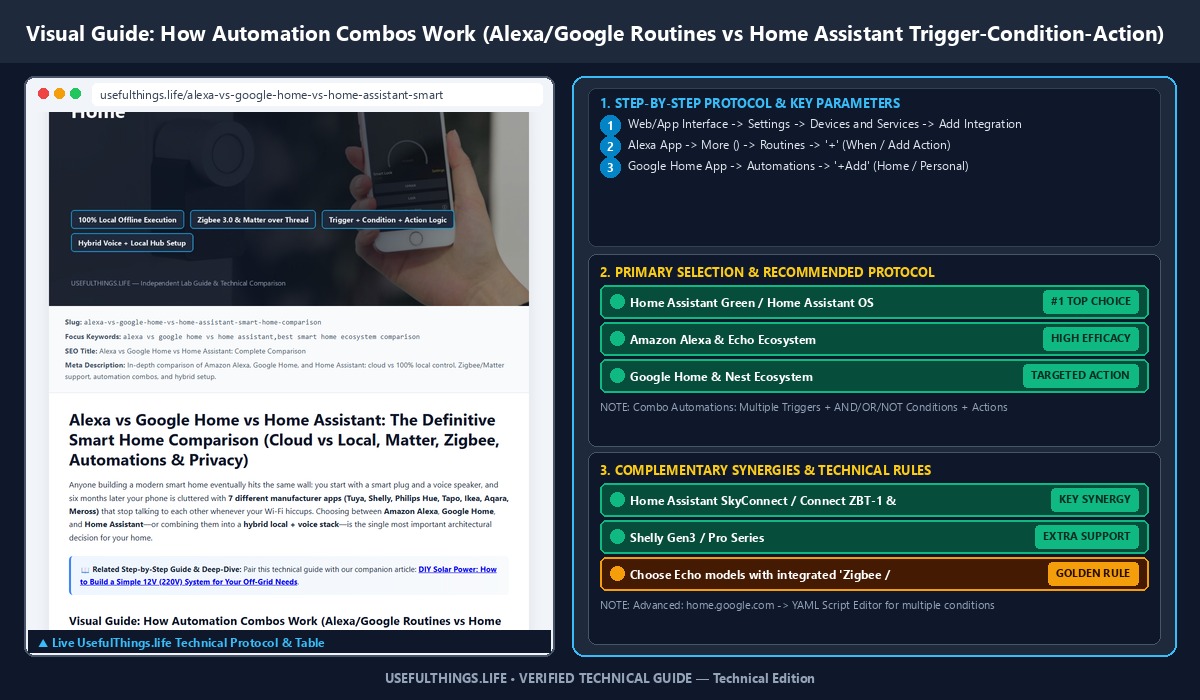
Quick Comparison & Reference Table: Alexa Vs Google Home Vs Home Assistant at a Glance
| # | Section / Step / System | Best For / Role | Navigation / Key Spec 1 | Combo / Key Spec 2 |
|---|---|---|---|---|
| #1 | Home Assistant Green / Home Assistant OS (The 100% Local Smart Home Brain) | Best Overall Smart Home Hub for Privacy, Speed & 2,500+ Brands | Web/App Interface → Settings → Devices and Services → Add Integration | Combo Automations: Multiple Triggers + AND/OR/NOT Conditions + Actions |
| #2 | Amazon Alexa & Echo Ecosystem (Echo 4th Gen / Echo Show / Echo Hub) | Best Plug-and-Play Voice Assistant & Simple Daily Routines | Alexa App → More (☰) → Routines → ‘+’ (When / Add Action) | Choose Echo models with integrated ‘Zigbee / Thread Smart Home Hub’ |
| #3 | Google Home & Nest Ecosystem (Nest Hub / Nest Audio / Google TV Streamer) | Best for Natural Language AI (Gemini), Android Phones & Cast Audio | Google Home App → Automations → ‘+Add’ (Home / Personal) | Advanced: home.google.com → YAML Script Editor for multiple conditions |
| #4 | Home Assistant SkyConnect / Connect ZBT-1 & Sonoff Zigbee 3.0 Dongle Plus | Best €25 USB Antenna to Connect 100+ Zigbee/Thread Sensors Without Hubs | Home Assistant → Integrations → Zigbee Home Automation (ZHA) or Zigbee2MQTT | Combo Channel: Use Zigbee Channel 25 to not interfere with 2.4GHz Wi-Fi |
| #5 | Shelly Gen3 / Pro Series (Wi-Fi, Bluetooth & Matter In-Wall Relays) | Best Smart Relays to Hide Behind Existing Italian Wall Switches (BTicino/Vimar) | Shelly App or Local IP (192.168.x.x) → Enable MQTT / Home Assistant / Alexa | Combo Switch: Set ‘Edge Switch’ to keep the physical buttons on the wall |
| #6 | Nabu Home (Home Assistant Cloud) vs Free Cloudflare Tunnel / Matter Bridge | Easiest 1-Click Way to Connect Home Assistant to Alexa & Google Home | Home Assistant → Settings → Home Assistant Cloud → Tick Entities to Expose | Select only the lights/shutters you want to control by voice so as not to clog up Alexa |
| #7 | Apple HomeKit & HomePod Mini (via Home Assistant HomeKit Bridge) | Best for iPhone, iPad & Apple Watch Households (100% Local Siri Control) | Home Assistant → Add Integration → ‘HomeKit Bridge’ → Scan QR on iPhone | Instantly expose $8 Shelly/Tuya/Zigbee devices in the Apple Home app |
| #8 | IKEA DIRIGERA & Vallhorn/Parasoll/Tretakt Zigbee Lineup | Best Cheap €7–€10 Smart Sensors & Plugs Available in Physical Stores | Pair directly to Zigbee Home Assistant Stick, Echo Zigbee or Dirigera Hub | Uses LADDA 1.2V rechargeable batteries (natively tested on IKEA sensors) |
| #9 | Aqara Hub M3 / Zigbee 3.0 & mmWave Presence Sensors (FP2 / FP1E) | Best Ultra-Mini Sensors & True Human Presence Detection (Even Sitting Still) | Aqara App / HomeKit / Home Assistant → Configure Room Zones (Sofa, Desk) | Replaces old PIR sensors that turn off the light if you’re reading still |
| #10 | ESPHome & Smart Energy Meters (Shelly EM / IAMMETER for Solar Self-Consumption) | Best Pro Integration for DIY Solar, LiFePO4 Batteries & Heat Pumps | Home Assistant → ‘Energy’ Dashboard → Configure Network, Solar Panels and Battery | Automation: Start air conditioner/boiler only when solar export > 1500W |
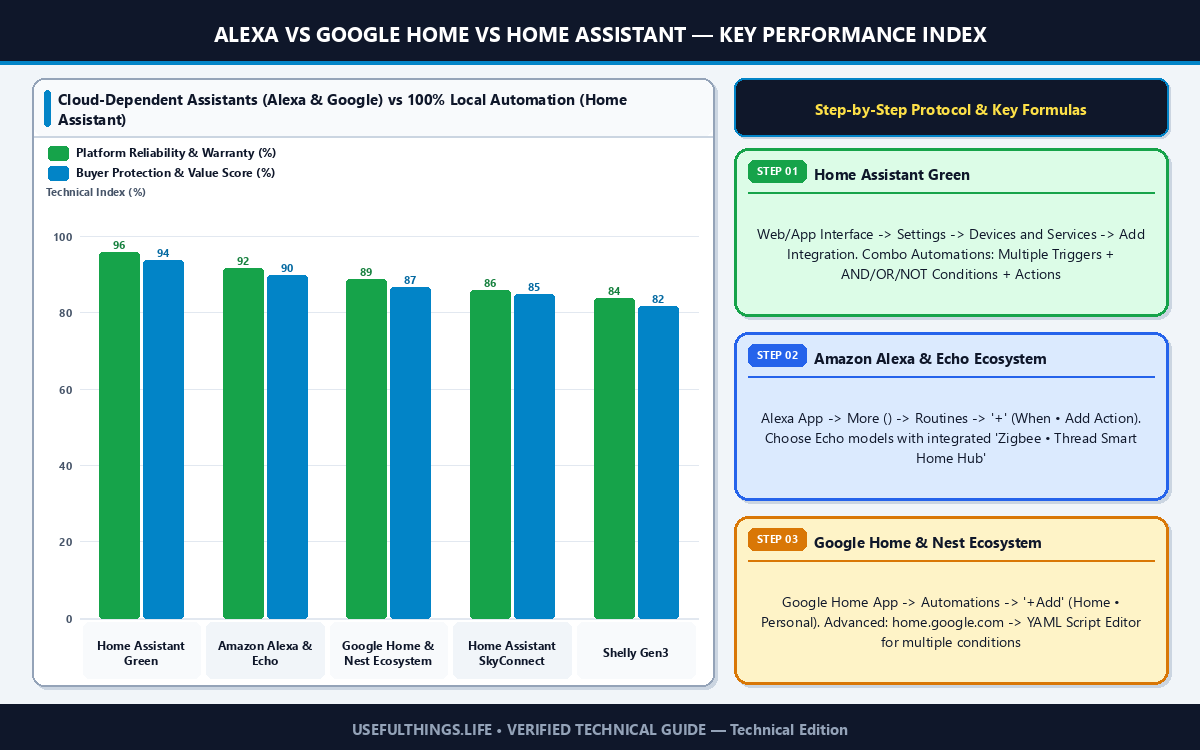
Cloud-Dependent Assistants (Alexa & Google) vs 100% Local Automation (Home Assistant)
When you tell Amazon Alexa or Google Home to turn on a Wi-Fi light, your voice travels to an external cloud server, which then calls the bulb manufacturer’s cloud in China or the US before sending a packet back to your living room—if your internet fiber drops, your wall switches and routines fail. Home Assistant runs locally on a tiny 5W box inside your home (such as Home Assistant Green or a mini PC with a Zigbee/Thread dongle): automations fire in 15 milliseconds with zero internet connection, and it bridges over 2,500 incompatible brands into one dashboard while still letting you use Echo or Nest speakers for voice commands.
Real-World Visual Inspection & Key Details (Alexa Vs Google Home Vs Home Assistant)
Wall-mounted tablet dashboard running Home Assistant locally: real-time solar inverter production, Zigbee/Matter sensors, climate control, and security cameras with zero cloud dependency.

Complete 10-Point Breakdown & Step-by-Step Analysis: Alexa Vs Google Home Vs Home Assistant
#1 Home Assistant Green / Home Assistant OS (The 100% Local Smart Home Brain) Best Overall Smart Home Hub for Privacy, Speed & 2,500+ Brands
In position #1 of our alexa vs google home vs home assistant analysis, Home Assistant Green / Home Assistant OS (The 100% Local Smart Home Brain) stands out by combining Web/App Interface → Settings → Devices and Services → Add Integration, Combo Automations: Multiple Triggers + AND/OR/NOT Conditions + Actions, and Works 100% Offline + Unifies Shelly, Hue, Ikea, Tuya, Solar Inverters & EV Chargers. Highlighted as Best Overall Smart Home Hub for Privacy, Speed & 2,500+ Brands, it provides a decisive technical benchmark.
Plug-and-play official hardware (Home Assistant Green) or free install on any Raspberry Pi/Mini PC; tracks exact home energy consumption (kWh/solar production) and executes complex multi-condition automations locally in milliseconds
Slightly steeper initial learning curve than a simple voice speaker (though recent UI updates eliminated YAML coding for 95% of tasks)
#2 Amazon Alexa & Echo Ecosystem (Echo 4th Gen / Echo Show / Echo Hub) Best Plug-and-Play Voice Assistant & Simple Daily Routines
In position #2 of our alexa vs google home vs home assistant analysis, Amazon Alexa & Echo Ecosystem (Echo 4th Gen / Echo Show / Echo Hub) stands out by combining Alexa App → More (☰) → Routines → ‘+’ (When / Add Action), Choose Echo models with integrated ‘Zigbee / Thread Smart Home Hub’, and Largest Catalog of ‘Works with Alexa’ Skills + Fast Voice Recognition. Highlighted as Best Plug-and-Play Voice Assistant & Simple Daily Routines, it provides a decisive technical benchmark.
Fastest way to get voice control in every room for €35–€90; full-size Echo (4th Gen), Echo Studio, and Echo Hub include a built-in Zigbee & Matter/Thread radio so you can pair Philips Hue or Ikea bulbs directly without their bridge
Routines lack complex ‘AND/OR’ boolean conditions (e.g. you cannot easily check 3 different sensor states simultaneously), and most skills require internet
#3 Google Home & Nest Ecosystem (Nest Hub / Nest Audio / Google TV Streamer) Best for Natural Language AI (Gemini), Android Phones & Cast Audio
In position #3 of our alexa vs google home vs home assistant analysis, Google Home & Nest Ecosystem (Nest Hub / Nest Audio / Google TV Streamer) stands out by combining Google Home App → Automations → ‘+Add’ (Home / Personal), Advanced: home.google.com → YAML Script Editor for multiple conditions, and Best Contextual Voice Understanding + Native Android Quick-Settings Tile. Highlighted as Best for Natural Language AI (Gemini), Android Phones & Cast Audio, it provides a decisive technical benchmark.
Understands natural conversational queries much better than Alexa, casts multi-room music and YouTube/Netflix effortlessly, and offers a hidden web-based Script Editor (home.google.com) for power users who want conditional logic
Fewer cheap third-party sensors support Google-native local triggers compared to Alexa and Home Assistant
#4 Home Assistant SkyConnect / Connect ZBT-1 & Sonoff Zigbee 3.0 Dongle Plus Best €25 USB Antenna to Connect 100+ Zigbee/Thread Sensors Without Hubs
In position #4 of our alexa vs google home vs home assistant analysis, Home Assistant SkyConnect / Connect ZBT-1 & Sonoff Zigbee 3.0 Dongle Plus stands out by combining Home Assistant → Integrations → Zigbee Home Automation (ZHA) or Zigbee2MQTT, Combo Channel: Use Zigbee Channel 25 to not interfere with 2.4GHz Wi-Fi, and Connects Ikea, Aqara, Sonoff, Philips Hue & Tuya Zigbee Devices to 1 Antenna. Highlighted as Best €25 USB Antenna to Connect 100+ Zigbee/Thread Sensors Without Hubs, it provides a decisive technical benchmark.
Plugging a single €25 USB coordinator into Home Assistant lets you throw away 5 separate manufacturer hubs: sensors from Ikea (€7), Aqara, and Sonoff form a single self-healing mesh network where every mains-powered plug acts as a repeater
Requires Home Assistant running on a Raspberry Pi, Home Assistant Green, or Mini PC
#5 Shelly Gen3 / Pro Series (Wi-Fi, Bluetooth & Matter In-Wall Relays) Best Smart Relays to Hide Behind Existing Italian Wall Switches (BTicino/Vimar)
In position #5 of our alexa vs google home vs home assistant analysis, Shelly Gen3 / Pro Series (Wi-Fi, Bluetooth & Matter In-Wall Relays) stands out by combining Shelly App or Local IP (192.168.x.x) → Enable MQTT / Home Assistant / Alexa, Combo Switch: Set ‘Edge Switch’ to keep the physical buttons on the wall, and 100% Local API + Power Metering (W/kWh) + Works with Alexa, Google & HA. Highlighted as Best Smart Relays to Hide Behind Existing Italian Wall Switches (BTicino/Vimar), it provides a decisive technical benchmark.
Tiny UL/CE certified modules that fit right inside standard Italian 503 wall boxes behind your existing Vimar or BTicino switches: your physical wall switches keep working even if the router is unplugged, while adding power monitoring and local Home Assistant/Alexa control
Installation on 230V mains wiring should be performed with the circuit breaker off (or by a qualified electrician)
#6 Nabu Home (Home Assistant Cloud) vs Free Cloudflare Tunnel / Matter Bridge Easiest 1-Click Way to Connect Home Assistant to Alexa & Google Home
In position #6 of our alexa vs google home vs home assistant analysis, Nabu Home (Home Assistant Cloud) vs Free Cloudflare Tunnel / Matter Bridge stands out by combining Home Assistant → Settings → Home Assistant Cloud → Tick Entities to Expose, Select only the lights/shutters you want to control by voice so as not to clog up Alexa, and Encrypted Remote Access + Instant Alexa/Google Voice Sync + Supports Open-Source Dev. Highlighted as Easiest 1-Click Way to Connect Home Assistant to Alexa & Google Home, it provides a decisive technical benchmark.
Instead of manually configuring AWS developer skills or router port-forwarding, enabling Home Assistant Cloud links all your local Zigbee/Z-Wave devices to Alexa and Google Home in 30 seconds and gives you encrypted smartphone access outside your home
Optional €7.50/month subscription (or you can use the free Matter Bridge / Cloudflare Tunnel DIY method)
#7 Apple HomeKit & HomePod Mini (via Home Assistant HomeKit Bridge) Best for iPhone, iPad & Apple Watch Households (100% Local Siri Control)
In position #7 of our alexa vs google home vs home assistant analysis, Apple HomeKit & HomePod Mini (via Home Assistant HomeKit Bridge) stands out by combining Home Assistant → Add Integration → ‘HomeKit Bridge’ → Scan QR on iPhone, Instantly expose $8 Shelly/Tuya/Zigbee devices in the Apple Home app, and 100% Local LAN Communication + Instant iPhone Control Center & CarPlay Buttons. Highlighted as Best for iPhone, iPad & Apple Watch Households (100% Local Siri Control), it provides a decisive technical benchmark.
Native HomeKit accessories are expensive, but Home Assistant’s built-in HomeKit Bridge generates a single QR code that imports all your cheap Zigbee, Shelly, and Tuya devices straight into Apple’s native Home app and Siri with 100% local LAN speed
Requires an Apple TV or HomePod mini at home if you want Siri control when away on 4G/5G
#8 IKEA DIRIGERA & Vallhorn/Parasoll/Tretakt Zigbee Lineup Best Cheap €7–€10 Smart Sensors & Plugs Available in Physical Stores
In position #8 of our alexa vs google home vs home assistant analysis, IKEA DIRIGERA & Vallhorn/Parasoll/Tretakt Zigbee Lineup stands out by combining Pair directly to Zigbee Home Assistant Stick, Echo Zigbee or Dirigera Hub, Uses LADDA 1.2V rechargeable batteries (natively tested on IKEA sensors), and Standard Zigbee 3.0 Open Protocol (Zero Vendor Lock-In). Highlighted as Best Cheap €7–€10 Smart Sensors & Plugs Available in Physical Stores, it provides a decisive technical benchmark.
Ikea’s latest smart plugs (€8), door/window sensors (€8), motion sensors (€9), and water leak detectors use clean, standard Zigbee 3.0—pairing in seconds directly with Home Assistant or Amazon Echo without even needing Ikea’s hub
Slightly bulkier plastic housing than ultra-mini Aqara sensors
#9 Aqara Hub M3 / Zigbee 3.0 & mmWave Presence Sensors (FP2 / FP1E) Best Ultra-Mini Sensors & True Human Presence Detection (Even Sitting Still)
In position #9 of our alexa vs google home vs home assistant analysis, Aqara Hub M3 / Zigbee 3.0 & mmWave Presence Sensors (FP2 / FP1E) stands out by combining Aqara App / HomeKit / Home Assistant → Configure Room Zones (Sofa, Desk), Replaces old PIR sensors that turn off the light if you’re reading still, and mmWave Radar Detects Micro-Breathing + Zigbee/Matter Multi-Ecosystem Support. Highlighted as Best Ultra-Mini Sensors & True Human Presence Detection (Even Sitting Still), it provides a decisive technical benchmark.
Traditional infrared (PIR) motion sensors turn the lights off on you if you sit still reading or working at a PC; Aqara’s mmWave radar sensors detect stationary human presence and divide a single room into up to 30 independent trigger zones
mmWave radar models require USB-C power rather than a coin cell battery
#10 ESPHome & Smart Energy Meters (Shelly EM / IAMMETER for Solar Self-Consumption) Best Pro Integration for DIY Solar, LiFePO4 Batteries & Heat Pumps
In position #10 of our alexa vs google home vs home assistant analysis, ESPHome & Smart Energy Meters (Shelly EM / IAMMETER for Solar Self-Consumption) stands out by combining Home Assistant → ‘Energy’ Dashboard → Configure Network, Solar Panels and Battery, Automation: Start air conditioner/boiler only when solar export > 1500W, and Pays for Your Entire Smart Home Hub in 1 Season via Zero Grid Waste. Highlighted as Best Pro Integration for DIY Solar, LiFePO4 Batteries & Heat Pumps, it provides a decisive technical benchmark.
By reading real-time watt clamps on your solar inverter and grid meter (via Shelly EM or ESPHome), Home Assistant automatically turns on your water heater, air conditioner, or dehumidifier using 100% free excess solar power instead of selling it to the grid for pennies
Only possible on Home Assistant (Alexa and Google Home lack native kWh energy dashboards)
Frequently Asked Questions (FAQ) on Alexa Vs Google Home Vs Home Assistant
What is the most important rule to remember about alexa vs google home vs home assistant?
When dealing with alexa vs google home vs home assistant and best smart home ecosystem comparison, always verify the exact selection combo or temperature/grading parameter shown in our step-by-step chart above before finalizing your choice.
How do the selection combos change the real-world outcome?
Selecting the recommended green-tier options in our UI & Automation Combos Compared: Alexa Routines vs Google Home vs Home Assistant walkthrough avoids the most common hidden pitfalls while maximizing reliability, warranty coverage, or culinary authenticity.




Leave a Reply