

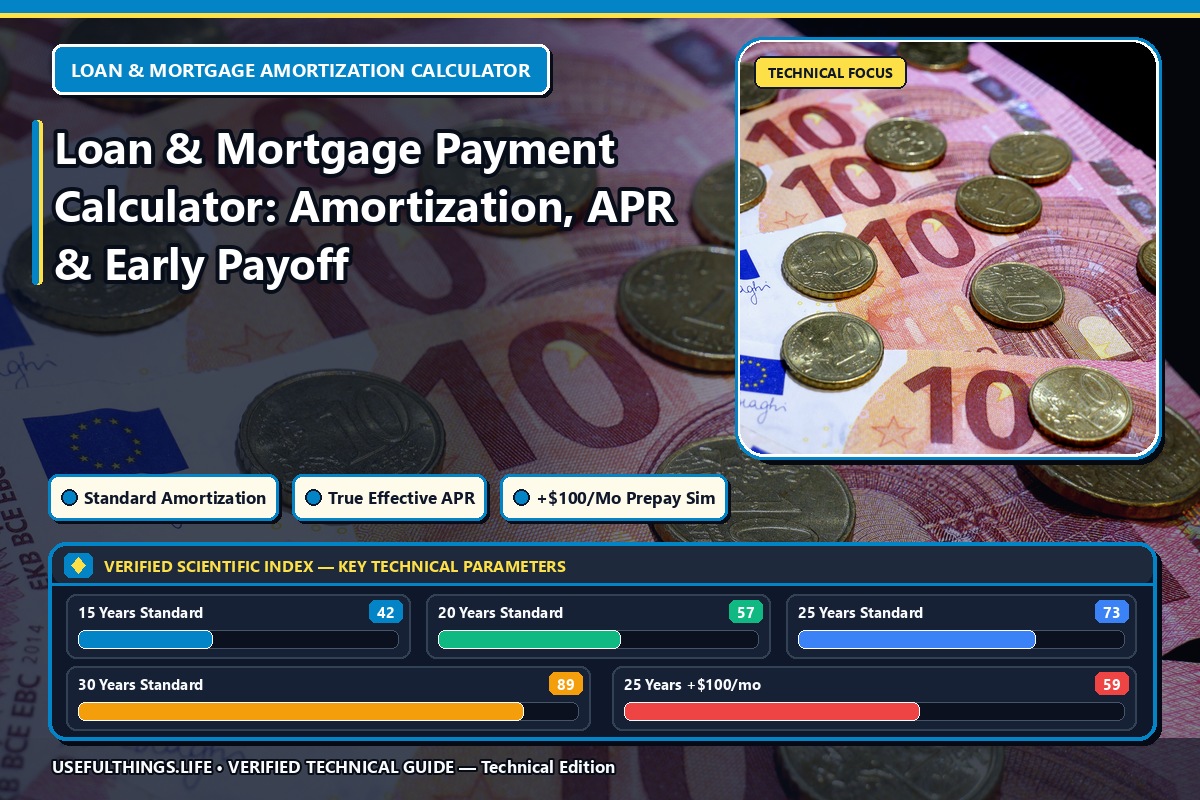
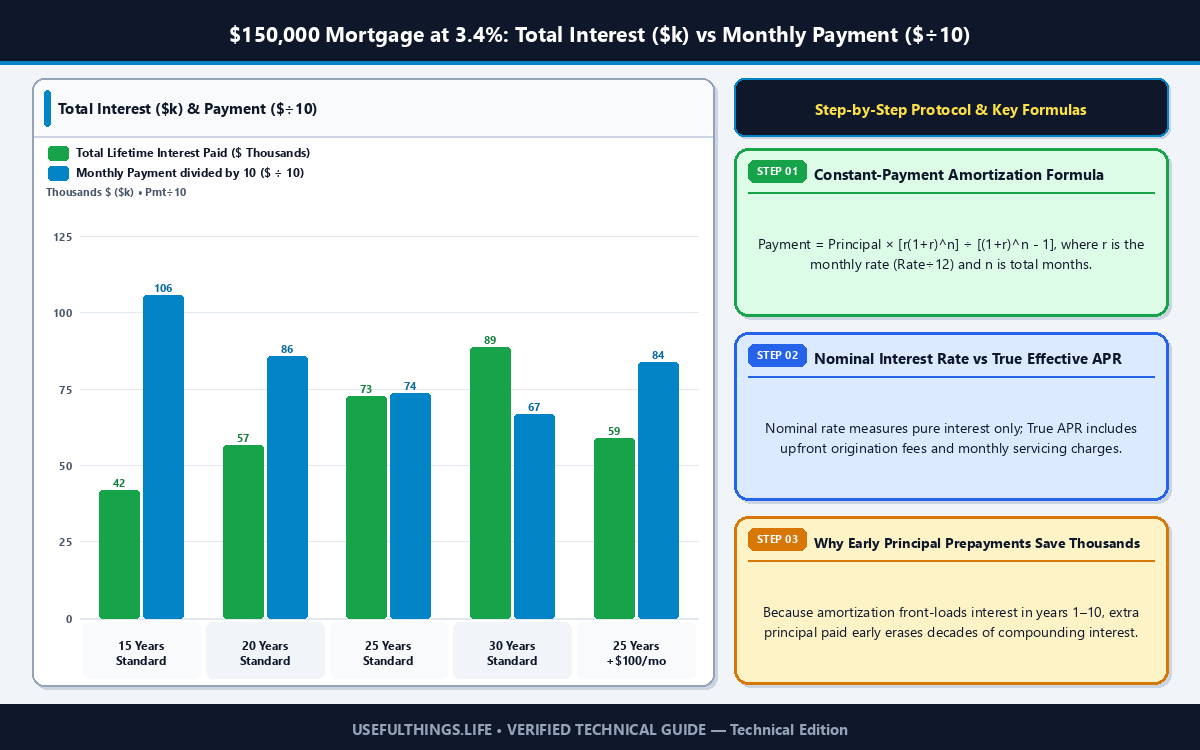
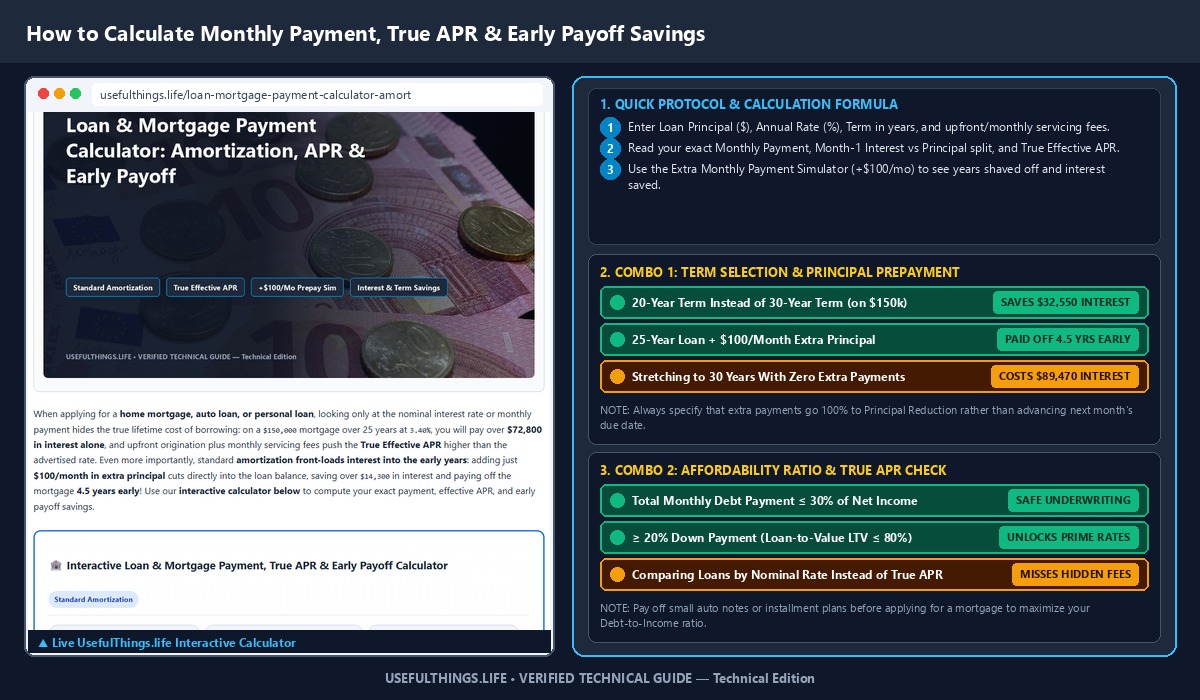
When applying for a home mortgage, auto loan, or personal loan, looking only at the nominal interest rate or monthly payment hides the true lifetime cost of borrowing: on a $150,000 mortgage over 25 years at 3.40%, you will pay over $72,800 in interest alone, and upfront origination plus monthly servicing fees push the True Effective APR higher than the advertised rate. Even more importantly, standard amortization front-loads interest into the early years: adding just $100/month in extra principal cuts directly into the loan balance, saving over $14,300 in interest and paying off the mortgage 4.5 years early! Use our interactive calculator below to compute your exact payment, effective APR, and early payoff savings.
🏦 Interactive Loan & Mortgage Payment, True APR & Early Payoff Calculator
Standard Amortization⚡ Extra Monthly Payment & Early Payoff Savings Simulator
Quick Reference & Core Formulas Comparison Table
| # | Loan Parameter / Strategy | Formula / Technical Rule | Example on $150,000 (25 yrs) | Real Financial Impact |
|---|---|---|---|---|
| #1 | Standard Constant-Payment Amortization Formula 99% Banking Standard | M = P × [r(1+r)^n] / [(1+r)^n – 1] | Decreasing Interest Share | Increasing Principal Share |
| #2 | Nominal Interest Rate vs True Effective APR True Cost Metric | Nominal: Pure interest only | APR: Includes origination & monthly fees | Mandatory legal disclosure |
| #3 | The +$100/Month Extra Principal Prepayment Strategy Saves $14,320 | +$100/mo on $150k (25y, 3.4%) | Interest saved: $14,320 | Cuts term by 4 yrs 5 mos |
| #4 | 20-Year vs 30-Year Mortgage Term: The Hidden Cost of Time +$32,550 Interest | 20 yrs ($150k at 3.4%): $862/mo | 30 yrs ($150k at 3.4%): $665/mo | Extra interest paid: +$32,551 |
| #5 | The 30% Debt-to-Income (DTI) Golden Affordability Rule Safe Approval Threshold | $3,000 net income ➔ Max $900 payment | Includes auto & credit card debt | Core underwriting metric |
| #6 | Fixed Rate vs Adjustable Rate (ARM) & Refinance Optionality Rate Architecture | Fixed: Locked for full term | ARM: Floating index + margin | Refinance/Subrogation option |
| #7 | Loan-to-Value (LTV ≤ 80%): Why a 20% Down Payment Cuts Your Rate 80% LTV Threshold | LTV ≤ 80%: Unlocks prime rates & zero PMI | LTV ≤ 60%: Lowest tier spread | >80% LTV triggers PMI fees |
| #8 | Zero-Cost Mortgage Subrogation & Rate Refinancing Break-Even Rate Drop ≥ 0.50% | Zero-fee lender subrogation / streamlined refi | US Refi: Check break-even months | Worthwhile at ≥0.50%–0.75% drop |
| #9 | Auto Loans & Balloon Payments (Guaranteed Future Value Traps) Watch True APR | Always check APR (often 7%–10%+) | Interest accrues on the balloon balance | Compare against credit union loans |
| #10 | Mortgage Interest Tax Deductions & Points Relief Schedule A & Points Relief | US: Deduct interest up to $750,000 loan principal | Points paid at closing deductible in Year 1 | Rental/investment property interest 100% deductible |
Detailed Technical Guide: Top 10 Practical Rules & Cases
#1 Standard Constant-Payment Amortization Formula 99% Banking Standard
Standard fixed-rate mortgages and auto loans keep the monthly payment constant across all months, but interest is calculated each month on the remaining balance: in year 1 of a 25-year 3.4% loan, 57% of your payment goes to interest and only 43% reduces your debt.
✅ Key Takeaways & Practical Advantages
- Predictable monthly cash-flow budgeting for families
- Every extra dollar paid goes 100% toward reducing principal balance
⚠️ Common Mistakes to Avoid
- Prepaying in the final 5 years saves very little interest because most interest was already collected in the first half
#2 Nominal Interest Rate vs True Effective APR True Cost Metric
The nominal rate reflects pure interest only, ignoring origination points, appraisal fees, mandatory insurance, and monthly payment servicing charges (e.g., $3/month = $900 over 25 years). Effective APR rolls all upfront and recurring fees into one comparable percentage.
✅ Key Takeaways & Practical Advantages
- Always compare competing loan offers using True APR rather than headline nominal rates
- On smaller $5,000–$10,000 loans, fixed origination fees can push APR 1.5%+ above the nominal rate
⚠️ Common Mistakes to Avoid
- Small $3–$4 monthly servicing fees silently add $1,000+ to a 30-year mortgage
#3 The +$100/Month Extra Principal Prepayment Strategy Saves $14,320
Adding just $100 a month toward principal ($1,200/year) triggers a compounding snowball in reverse: every dollar of principal eliminated today erases 20+ years of future interest charges on that dollar.
✅ Key Takeaways & Practical Advantages
- Delivers a guaranteed, risk-free return equal to your loan’s interest rate
- Shaves 4.5 years off a 25-year mortgage without straining monthly cash flow
⚠️ Common Mistakes to Avoid
- Always instruct the lender to apply extra payments to ‘Principal Reduction’ rather than advancing next month’s due date
#4 20-Year vs 30-Year Mortgage Term: The Hidden Cost of Time +$32,550 Interest
Stretching a $150,000 mortgage from 20 to 30 years lowers the monthly payment by $197 (from $862 to $665), but balloons total lifetime interest from $56,925 to $89,476 — costing $32,551 extra for the exact same house.
✅ Key Takeaways & Practical Advantages
- Choosing a 20-year term builds home equity nearly twice as fast in the first decade
⚠️ Common Mistakes to Avoid
- If you take a 30-year loan for safety flexibility, make voluntary extra principal payments as if it were a 20-year loan
#5 The 30% Debt-to-Income (DTI) Golden Affordability Rule Safe Approval Threshold
Lenders approve mortgages smoothly when your total monthly debt obligations (mortgage + car loan + minimum card payments) stay at or below 30%–33% of net take-home household income.
✅ Key Takeaways & Practical Advantages
- Protects family cash flow against emergencies and utility spikes
- Secures top-tier credit underwriting approval
⚠️ Common Mistakes to Avoid
- Pay off small installment plans or car notes before applying for a mortgage to maximize borrowing power
#6 Fixed Rate vs Adjustable Rate (ARM) & Refinance Optionality Rate Architecture
A fixed-rate loan locks your payment for the entire 15–30 year horizon, whereas an adjustable-rate mortgage (ARM) floats with benchmark rates. When long-term fixed rates are below 4%, locking a fixed rate gives asymmetric protection: you are shielded if rates rise, and can refinance if rates drop.
✅ Key Takeaways & Practical Advantages
- Complete immunity against central bank rate hikes
- Peace of mind across multi-decade horizons
⚠️ Common Mistakes to Avoid
- Adjustable-rate caps often carry a higher initial margin than plain fixed loans
#7 Loan-to-Value (LTV ≤ 80%): Why a 20% Down Payment Cuts Your Rate 80% LTV Threshold
Loan-to-Value (loan amount divided by appraised home value) governs lender risk pricing: keeping LTV at or below 80% (a 20% down payment) unlocks prime interest rates and eliminates Private Mortgage Insurance (PMI).
✅ Key Takeaways & Practical Advantages
- Dropping from 85% to 80% LTV lowers your rate by 0.25%–0.50% and removes PMI
- Immediate 20% equity cushion
⚠️ Common Mistakes to Avoid
- Always keep an extra 5%–8% cash reserve for closing costs, taxes, and moving expenses
#8 Zero-Cost Mortgage Subrogation & Rate Refinancing Break-Even Rate Drop ≥ 0.50%
When market interest rates drop by 0.50% to 0.75% below your current mortgage rate, transferring/refinancing the remaining balance into a lower fixed rate can save $15,000+ over the remaining term.
✅ Key Takeaways & Practical Advantages
- On a $140,000 balance with 20 years left, cutting rate from 4.2% to 3.2% saves $17,400
⚠️ Common Mistakes to Avoid
- Divide any closing costs by your monthly payment savings to verify your break-even is under 18 months
#9 Auto Loans & Balloon Payments (Guaranteed Future Value Traps) Watch True APR
Dealer balloon loans advertise low monthly payments for 36 months followed by a large final buyout payment — but you pay monthly interest on that entire unamortized balloon balance for all 3 years! Refinancing the balloon adds another 3–4 years of interest.
✅ Key Takeaways & Practical Advantages
- Use our calculator to compare a straight 48-month bank loan against dealer balloon financing
⚠️ Common Mistakes to Avoid
- A $1,500 ‘finance rebate’ is a net loss if the loan charges $4,500 in interest and bundled add-ons
#10 Mortgage Interest Tax Deductions & First-Year Points Relief Schedule A & Points Relief
In the United States and several international jurisdictions, mortgage borrowers can reduce their taxable income through mortgage interest tax relief—such as the US IRS Schedule A itemized deduction on mortgage interest up to $750,000 of acquisition debt, first-year discount points deduction, and full rental-property interest offsets against rental income.
✅ Key Takeaways & Practical Advantages
- Effectively lowers your net cost of borrowing during the high-interest early years of the mortgage
⚠️ Common Mistakes to Avoid
- Keep all annual bank interest certificates and first-year appraisal/notary invoices for tax filing






Leave a Reply