

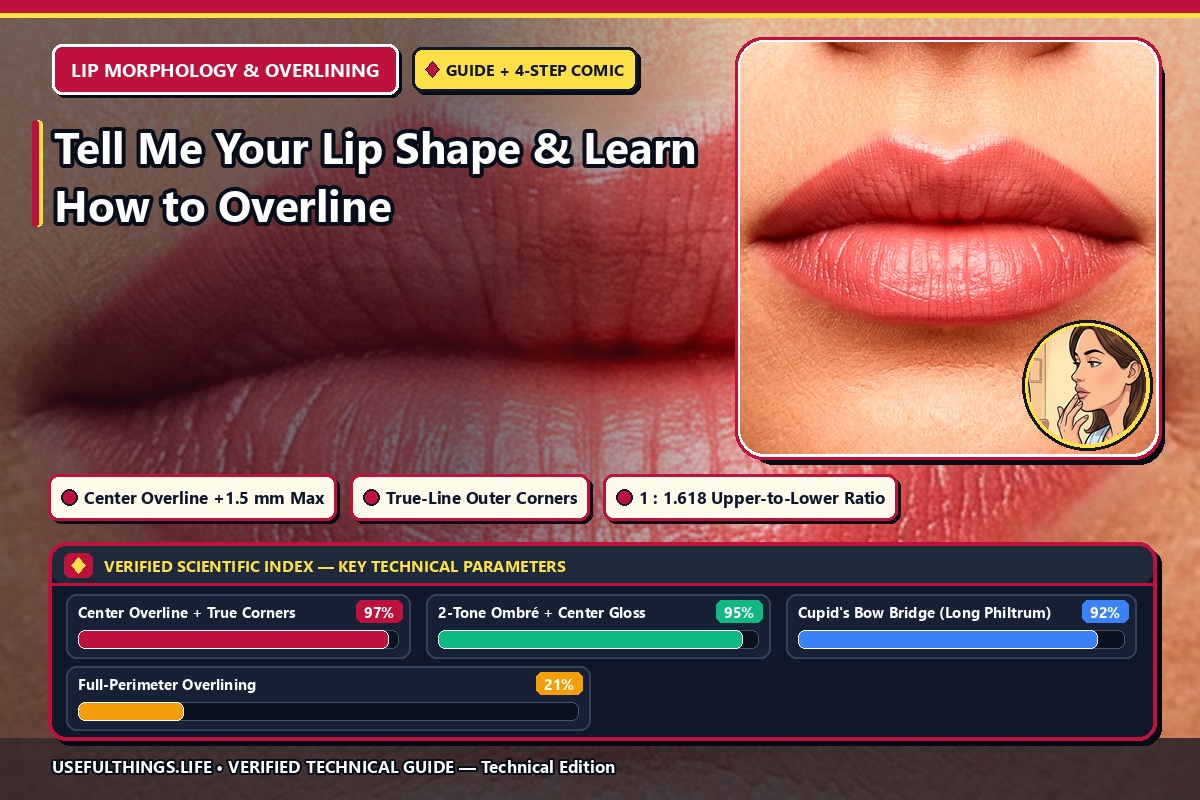
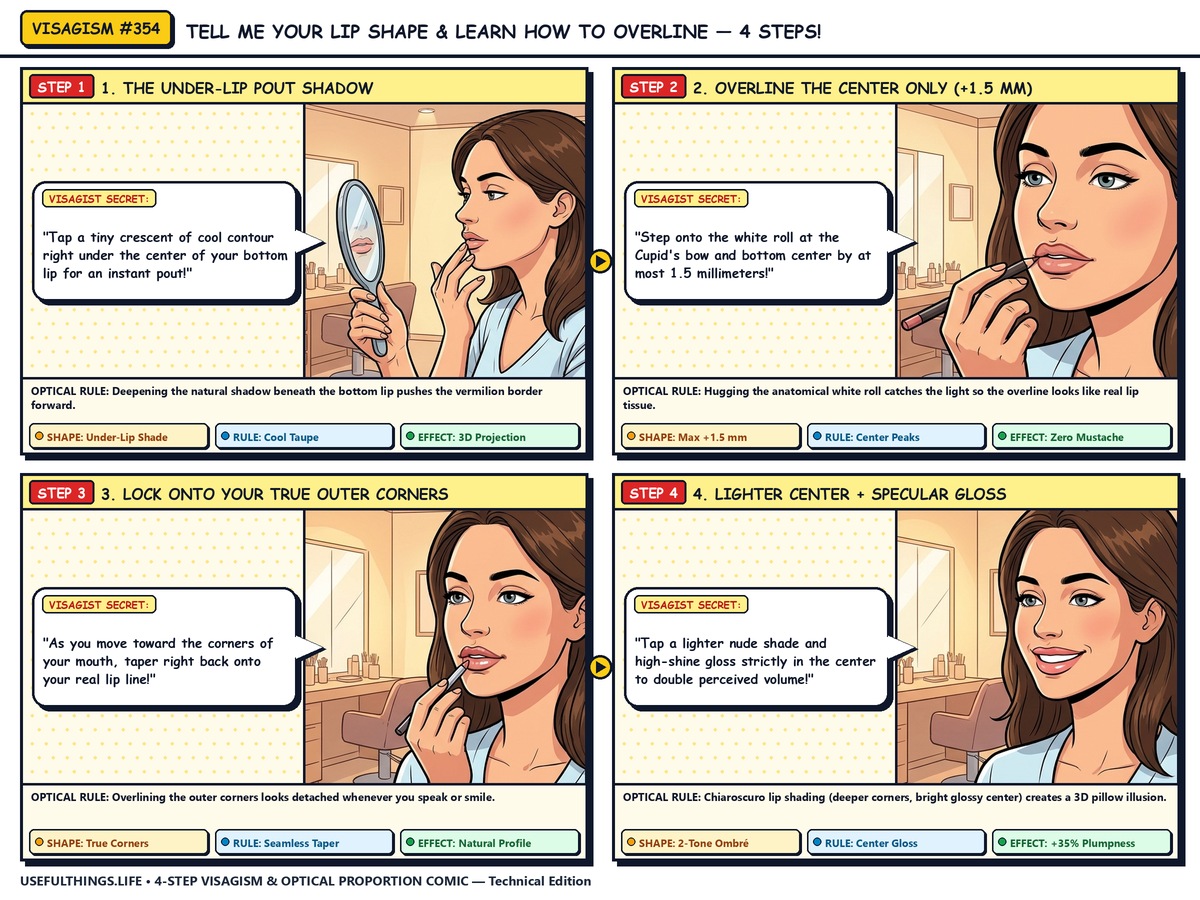
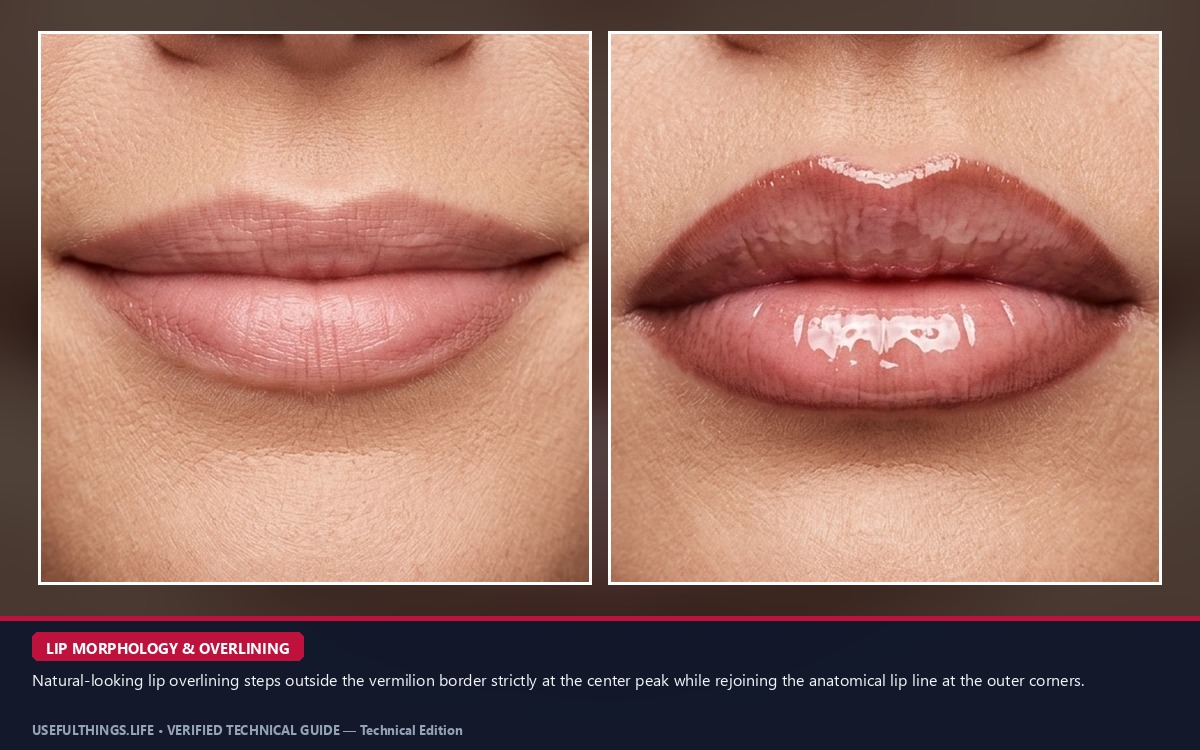
Why does overlining sometimes look like a clown mustache in daylight? Because people overline the outer corners! The golden rule of lip visagism: overline by 1 to 1.5 mm strictly at the center (Cupid's bow and center bottom lip), then taper right back onto your real anatomical lip line along the outer thirds.
Craniofacial anthropometry shows that balanced lips often follow a 1 : 1.618 (or 1 : 1) upper-to-lower vertical ratio, yet M-shaped ('gull-wing') lips, thin upper lips, downturning corners, and long philtrums each require a specific liner vector. Tracing outside your entire lip perimeter flattens the natural 3D roll of the vermilion border. Use our interactive Lip Morphology & Overlining Advisor below.
🪞 Lip Shape & Custom Overlining Calculator (1:1.618 Ratio)
LIVE VISAGISM ADVISOR
Select your natural lip shape and philtrum length to get your custom lip-liner and 3D ombré blueprint.
–
4-Step Photographic Guide — Tell Me Your Lip Shape & Learn How to Overline


4-Panel Visagist Comic: Proportions & Optical Illusions
Comparative Chart & Technical Table — Tell Me Your Lip Shape & Learn How to Overline

| Lip Morphology | Where to Overline (+1 to 1.5 mm) | Where to Hug True Lip Line | Ideal Formula Finish | Primary Optical Result |
|---|---|---|---|---|
| Thin Lips | Bridged Cupid's bow + center bottom peak | Outer thirds all the way to corners | Satin cream + high-shine center gloss | Increases vertical lip height by 30% |
| M-Shaped (Gull-Wing) | The two concave outer slopes of upper lip | Central M-peaks and outer corners | Plumping cream with lighter center | Fills lateral dips for lush oval fullness |
| Thin Top Lip Only | Upper Cupid's bow and upper-center slopes | Entire bottom lip stays on true line | Gloss concentrated on upper lip | Balances upper-to-lower ratio to 1:1.2 |
| Downturned Corners | Upper center + tiny upward flick at corners | Stop bottom liner 2 mm before corners | Concealer at corners + satin tint | Lifts resting mouth expression |
| Small • Narrow Mouth | Extend outer corners horizontally by 1 mm | Upper and lower vertical peaks | Soft satin across full width | Widens horizontal smile proportion |
Morphological Analysis, Golden Rules & Optical Myths to Avoid
1. How to Pick the Exact Lip Liner Shade for Undetectable Overlining
COLORIMETRY SECRET
Optical & Morphological Rule: Warm brick-orange or overly dark liners expose the exact millimeter where your real lip ends and flat skin begins.
Choose a liner just 1 shade deeper than your natural inner lip with a cool rosy-taupe or muted mauve undertone—it mimics a real 3D lip shadow.
Always feather the inner edge of the liner inward with a lip brush before applying lipstick so there is zero harsh ring.
2. 'Oval Lip Lining' vs Crisp Cupid's Bow: Check Your Philtrum Length First
PHILTRUM GEOMETRY
Optical & Morphological Rule: Should you bridge straight across your Cupid's bow ('Brentz • Oval lining') or keep the V sharp? Measure the space between your nose and top lip!
If you have a long philtrum (> 15 mm), rounding across the Cupid's bow shortens the mid-face and plumps the top lip; if your philtrum is short, keep the crisp V peak!
Bridging the Cupid's bow on an already short philtrum can crowd the space under the nose.
3. How to Stop Overlined Lipstick from Feathering into Fine Vertical Lines
ANTI-FEATHERING LOCK
Optical & Morphological Rule: Creamy lipsticks travel by capillary action into fine perioral lines when applied outside the vermilion border.
Blot away lip balm completely before lining, trace a clear wax barrier pencil around the outer border, and use a long-wear gel-matte lip pencil.
Keep glossy liquid formulas concentrated in the center of the lips rather than heavy on the overlined border.
4. The Myth of 'Blanking Out Your Entire Lips with Foundation First'
❌ OPTICAL MYTH • MISTAKE
Optical & Morphological Rule: Coating your entire lips in foundation before overlining is a dated backstage trick that backfires in real life.
Foundation dehydrates lip skin, turns lipstick shades chalky grey, and cracks along vertical lip creases within an hour.
Use concealer strictly around the outer lower mouth corners to clean up and lift the edge.
Frequently Asked Questions (FAQ)
❓ Which lipstick shades make thin lips look the fullest?
Luminous rosy nudes, soft peach, warm mauve, and bright satin reds reflect light and expand volume; very dark matte shades (deep plum, espresso,vampy burgundy) absorb light and shrink perceived lip size.
❓ Should I overline before or after applying lipstick?
Map your border with a sharpened pencil on dry, balm-free lips BEFORE lipstick for maximum grip and symmetry, then tap lipstick into the center.
❓ Should I still put highlighter on my Cupid's bow if I overline?
Skip shimmer highlighter above an overlined Cupid's bow—it highlights the skin edge and gives away the overline! Put your shine strictly on the center of the lips instead.
❓ How do I make overlined lips last through coffee and meals?
Use a peel-off lip stain or waterproof gel lip liner for the 1.5 mm center overline, let it set for 30 seconds before adding gloss, and keep oil-based glosses in the center only.
🔗 Related Technical Guides & Calculators
- Natural Health & Daily Wellness Remedies
- Everyday Home Tips & Eco Cleaning Guides
- Practical Calculators & Interactive Tools
📚 Scientific Sources, Anthropometry & References
- Journal of Investigative Dermatology — Facial Anthropometry & Optical Symmetry Studies
- International Journal of Cosmetic Science — Colorimetry, Hair Fiber Optics & Visagism
- American Academy of Dermatology (AAD) — Clinical Skin Barrier & Hair Morphology Guidelines






Leave a Reply