

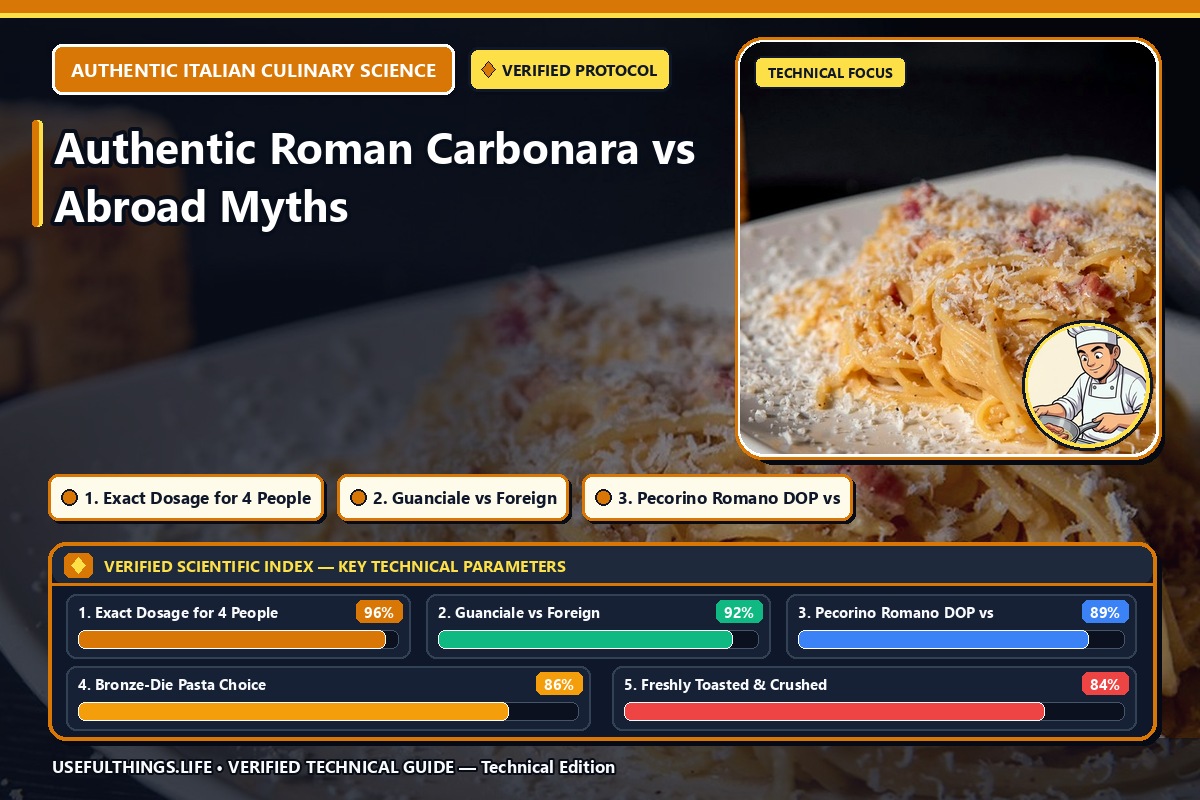
Outside Italy, Pasta alla Carbonara is the most distorted Italian recipe on earth: abroad it is routinely drowned in heavy cream, sautéed with garlic and onions, cooked with smoked streaky bacon, and topped with chicken or green peas. In Rome, authentic Carbonara relies on strictly 5 ingredients—bronze-die pasta, cured pork jowl (Guanciale), Pecorino Romano DOP, fresh egg yolks, and toasted coarse black pepper—transformed into a glossy golden sauce through a precise 62°C physico-chemical emulsion (‘Carbocrema’).
Authentic Ingredient Combos vs Foreign Mistakes & Step-by-Step Dosage
Inspect our annotated visual guide below comparing the authentic Roman 5-ingredient selection combo against the most common abroad errors, complete with the exact 4-serving gram weights.
Step-by-Step Culinary Comic Storyboard (4 Key Phases)

Quick Comparison & Reference Table: Authentic Roman Carbonara Recipe at a Glance
| # | Section / Step / System | Best For / Role | Navigation / Key Spec 1 | Combo / Key Spec 2 |
|---|---|---|---|---|
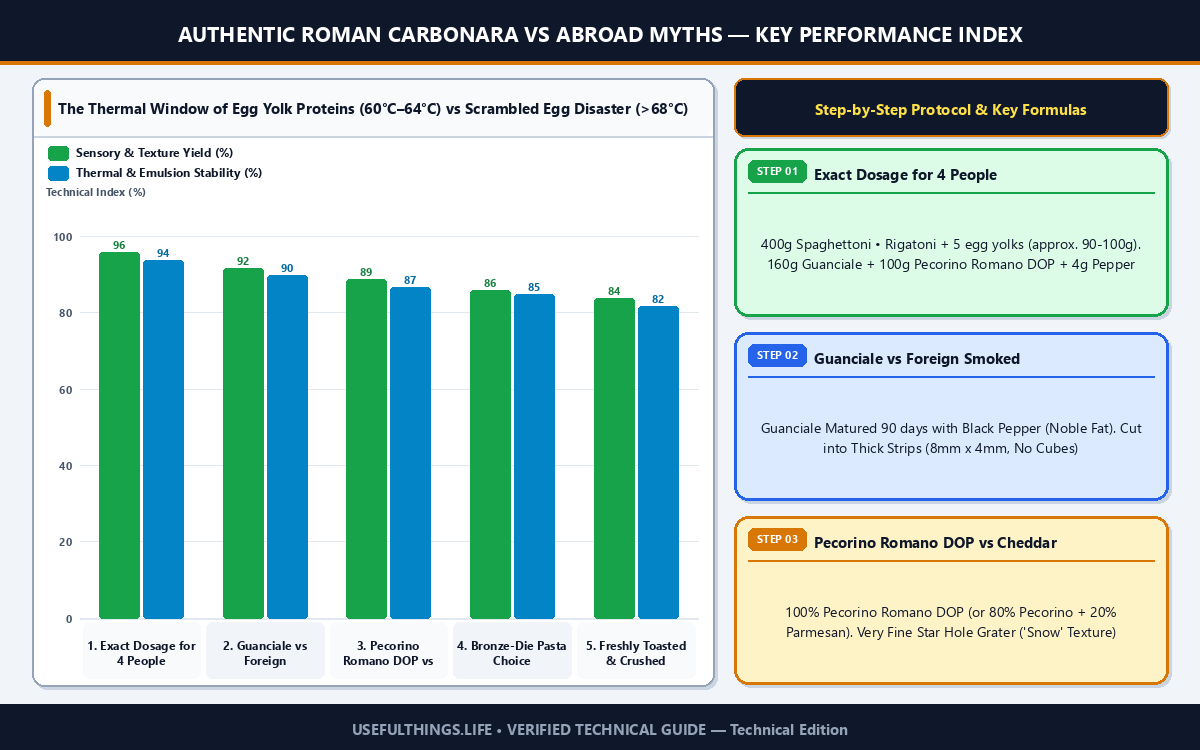
| #1 | 1. Exact Dosage for 4 People | 380g–400g Pasta + 160g Guanciale + 5 Egg Yolks + 100g Pecorino DOP | 400g Spaghettoni / Rigatoni + 5 egg yolks (approx. 90-100g) | 160g Guanciale + 100g Pecorino Romano DOP + 4g Pepper |
| #2 | 2. Guanciale (Cured Pork Cheek) vs Foreign Smoked Bacon / Pancetta | Why Pork Jowl Fat Has a Superior Melting Profile & Aroma | Guanciale Matured 90 days with Black Pepper (Noble Fat) | Cut into Thick Strips (8mm x 4mm, No Cubes) |
| #3 | 3. Pecorino Romano DOP (aged 5–8 Months) vs Cheddar / Grana Overload | How to Grate Pecorino into a Micro-Powder That Melts Without Strings | 100% Pecorino Romano DOP (or 80% Pecorino + 20% Parmesan) | Very Fine Star Hole Grater (‘Snow’ Texture) |
| #4 | 4. Bronze-Die Pasta Choice: Spaghettoni, Rigatoni or Mezze Maniche | Why Rough Bronze-Extruded Surface & High Starch Release Are Essential | Spaghettoni Quadrati / Rigatoni / Mezze Maniche Rigate | Bronze Drawing + Slow Drying (<50°C) |
| #5 | 5. Freshly Toasted & Crushed Black Peppercorns | Unlocking Piperine Essential Oils in a Dry Skillet Before Grinding | Tellicherry or Sarawak Black Pepper in Whole Grains | Dry Roasting 90 Seconds + Pestle / Coarse Grinder |
| #6 | 6. Step 1 — Cold-Pan Rendering of the Guanciale | Start in a Cold Skillet Over Low-Medium Heat for 8–10 Minutes | Pan in Steel/Iron or Thick Aluminum (No Oil) | Gentle heat for 8–10 minutes until golden and translucent |
| #7 | 7. Step 2 — Whisking the ‘Carbocrema’ Paste in a Steel Bowl | Emulsifying Yolks, Pecorino & Warm Guanciale Fat into a Thick Paste | 5 egg yolks + 100g Pecorino + Toasted Pepper in Steel Bowl | Add 2 Tablespoons of Warm Melted Fat (45°C–50°C) in a Drizzle |
| #8 | 8. Step 3 — Off-Heat Mantecatura or 62°C Bain-Marie | How Chefs Guarantee Zero Scrambled Eggs Every Single Time | Drain the Pasta al Dente in the Steel Bowl (Off the Heat) | Rest the Bowl for 20 Seconds on the Steam of the Pot (62°C) |
| #9 | 9. The 5 Deadliest Foreign Carbonara Myths Debunked | Why Heavy Cream, Garlic, Onion, Peas & Chicken Ruin the Dish | Myth #1: Heavy Cream → Covers everything and weighs you down | Myth #2: Garlic, Onion, Parsley and White Wine |
| #10 | 10. Plating & Final Crunch: Crispy Guanciale on Top at Service | Keep Half the Crispy Guanciale Separate Until the Final Second | Deep Dishes Preheated to 45°C (Avoid Thermal Shock) | Final sprinkling of Pecorino + Pepper + Crispy Guanciale |
The Thermal Window of Egg Yolk Proteins (60°C–64°C) vs Scrambled Egg Disaster (>68°C)
Why do people abroad add heavy cream to Carbonara? Because when you toss raw eggs into a sizzling-hot frying pan over an active burner (>70°C), the egg proteins denature violently into dry curds—and cooks abroad use cream to mask that mistake. By whisking egg yolks with finely grated Pecorino Romano and a splash of warm rendered guanciale fat + starchy pasta water off the heat between 60°C and 64°C (140°F–147°F), you achieve a silky, pasteurized custard with zero cream.
Real-World Visual Inspection & Key Details (Authentic Roman Carbonara Recipe)
The glossy velvet coating of authentic Roman Carbonara comes from zero heavy cream: it is a stable physico-chemical emulsion of egg yolk lecithin, warm rendered guanciale fat, finely grated Pecorino, and starchy pasta water between 60°C and 64°C.

Visual Guide to the 4 Authentic Roman Carbonara Ingredients & Markers
In the photographic identification board and the 4 reference cards below, compare at a glance the 4 key visual targets covered in this guide so you can recognize them immediately:

Complete 10-Point Breakdown & Step-by-Step Analysis: Authentic Roman Carbonara Recipe
#1 1. Exact Dosage for 4 People 380g–400g Pasta + 160g Guanciale + 5 Egg Yolks + 100g Pecorino DOP
In position #1 of our authentic roman carbonara recipe analysis, 1. Exact Dosage for 4 People stands out by combining 400g Spaghettoni / Rigatoni + 5 egg yolks (approx. 90-100g), 160g Guanciale + 100g Pecorino Romano DOP + 4g Pepper, and Rule: 1 Yolk per Person + 1 Extra Yolk ‘for the Bowl’. Highlighted as 380g–400g Pasta + 160g Guanciale + 5 Egg Yolks + 100g Pecorino DOP, it provides a decisive technical benchmark.
Using exclusively egg yolks (5 yolks for 400g of pasta, zero egg whites) removes the watery albumin that coagulates at a lower temperature and turns slimy, giving you a rich golden coating on every single rigatone
Reduce the cooking water salt to 50% of normal because both Guanciale and Pecorino Romano DOP are naturally very savory
#2 2. Guanciale (Cured Pork Cheek) vs Foreign Smoked Bacon / Pancetta Why Pork Jowl Fat Has a Superior Melting Profile & Aroma
In position #2 of our authentic roman carbonara recipe analysis, 2. Guanciale (Cured Pork Cheek) vs Foreign Smoked Bacon / Pancetta stands out by combining Guanciale Matured 90 days with Black Pepper (Noble Fat), Cut into Thick Strips (8mm x 4mm, No Cubes), and Never Add Oil or Butter to the Pan. Highlighted as Why Pork Jowl Fat Has a Superior Melting Profile & Aroma, it provides a decisive technical benchmark.
Guanciale comes from the pig’s cheek and neck: its fat is rich in oleic acid, melts cleanly starting at 40°C, and carries intense aromas of black pepper and curing spices—whereas Anglo-Saxon smoked bacon introduces overpowering liquid smoke and water
Slice off the outer yellowed rind and heavy pepper crust before cutting into thick strips so the pepper doesn’t burn bitter in the pan
#3 3. Pecorino Romano DOP (aged 5–8 Months) vs Cheddar / Grana Overload How to Grate Pecorino into a Micro-Powder That Melts Without Strings
In position #3 of our authentic roman carbonara recipe analysis, 3. Pecorino Romano DOP (aged 5–8 Months) vs Cheddar / Grana Overload stands out by combining 100% Pecorino Romano DOP (or 80% Pecorino + 20% Parmesan), Very Fine Star Hole Grater (‘Snow’ Texture), and Keep Temperature Below 65°C to Prevent Casein Clumping. Highlighted as How to Grate Pecorino into a Micro-Powder That Melts Without Strings, it provides a decisive technical benchmark.
Aged sheep’s milk Pecorino Romano provides the sharp, lactic tang that cuts through the richness of egg yolk and pork fat; grating it into a fluffy micro-powder allows it to dissolve into the yolks instead of clumping into rubbery strings
If your Pecorino is aged over 12 months and very salty, use an 80g Pecorino + 20g Parmigiano Reggiano 24m blend
#4 4. Bronze-Die Pasta Choice: Spaghettoni, Rigatoni or Mezze Maniche Why Rough Bronze-Extruded Surface & High Starch Release Are Essential
In position #4 of our authentic roman carbonara recipe analysis, 4. Bronze-Die Pasta Choice: Spaghettoni, Rigatoni or Mezze Maniche stands out by combining Spaghettoni Quadrati / Rigatoni / Mezze Maniche Rigate, Bronze Drawing + Slow Drying (<50°C), and Cook in 30% Less Water to Concentrate Starch. Highlighted as Why Rough Bronze-Extruded Surface & High Starch Release Are Essential, it provides a decisive technical benchmark.
Bronze-extruded pasta has a porous, chalky micro-rough surface that sheds amylose starch into the boiling water; cooking the pasta in slightly less water than usual creates a milky, starchy liquid that acts as a natural emulsifier
Avoid smooth Teflon-extruded industrial pasta—the carbocrema will slide right off onto the bottom of the plate
#5 5. Freshly Toasted & Crushed Black Peppercorns Unlocking Piperine Essential Oils in a Dry Skillet Before Grinding
In position #5 of our authentic roman carbonara recipe analysis, 5. Freshly Toasted & Crushed Black Peppercorns stands out by combining Tellicherry or Sarawak Black Pepper in Whole Grains, Dry Roasting 90 Seconds + Pestle / Coarse Grinder, and Half in the Yolk Paste, Half Finely Crushed on Top. Highlighted as Unlocking Piperine Essential Oils in a Dry Skillet Before Grinding, it provides a decisive technical benchmark.
Pre-ground pepper dust has lost 80% of its volatile aromatics; toasting whole black peppercorns in a dry pan until they crackle and crushing them coarsely in a mortar releases warm, citrusy piperine notes that define authentic Carbonara
Never use fine grey pepper powder—it turns the yellow sauce muddy grey instead of speckled with black flecks
#6 6. Step 1 — Cold-Pan Rendering of the Guanciale Start in a Cold Skillet Over Low-Medium Heat for 8–10 Minutes
In position #6 of our authentic roman carbonara recipe analysis, 6. Step 1 — Cold-Pan Rendering of the Guanciale stands out by combining Pan in Steel/Iron or Thick Aluminum (No Oil), Gentle heat for 8–10 minutes until golden and translucent, and Separate Crispy Strips from Warm Liquid Fat. Highlighted as Start in a Cold Skillet Over Low-Medium Heat for 8–10 Minutes, it provides a decisive technical benchmark.
Place the thick guanciale strips into a completely cold pan with zero added oil and turn the heat to medium-low: the fat slowly renders into golden liquid while the meat turns crispy outside and tender inside
Remove the crispy guanciale with a slotted spoon onto a warm saucer—never leave it in the wet pasta water or it will lose all its crunch
#7 7. Step 2 — Whisking the ‘Carbocrema’ Paste in a Steel Bowl Emulsifying Yolks, Pecorino & Warm Guanciale Fat into a Thick Paste
In position #7 of our authentic roman carbonara recipe analysis, 7. Step 2 — Whisking the ‘Carbocrema’ Paste in a Steel Bowl stands out by combining 5 egg yolks + 100g Pecorino + Toasted Pepper in Steel Bowl, Add 2 Tablespoons of Warm Melted Fat (45°C–50°C) in a Drizzle, and Whisk Until It Resembles Thick Pastry Cream. Highlighted as Emulsifying Yolks, Pecorino & Warm Guanciale Fat into a Thick Paste, it provides a decisive technical benchmark.
Whisk the egg yolks with 80% of the Pecorino and toasted pepper, then slowly drizzle in two tablespoons of warm (not boiling!) rendered guanciale fat just like making mayonnaise, plus a tablespoon of starchy pasta water
If the guanciale fat is still above 80°C when poured into the yolks, it will cook spots of egg immediately—let it cool for 2 minutes first
#8 8. Step 3 — Off-Heat Mantecatura or 62°C Bain-Marie How Chefs Guarantee Zero Scrambled Eggs Every Single Time
In position #8 of our authentic roman carbonara recipe analysis, 8. Step 3 — Off-Heat Mantecatura or 62°C Bain-Marie stands out by combining Drain the Pasta al Dente in the Steel Bowl (Off the Heat), Rest the Bowl for 20 Seconds on the Steam of the Pot (62°C), and Toss Vigorously Adding 1–2 Spoons of Starch Water. Highlighted as How Chefs Guarantee Zero Scrambled Eggs Every Single Time, it provides a decisive technical benchmark.
Drain the al dente pasta into the pan with the remaining guanciale fat (burner OFF for 60 seconds), then transfer into the steel bowl with the yolk paste; resting the bowl briefly over the steaming pasta pot warms the emulsion to exactly 62°C
Never put the pan back over a direct gas flame or high induction burner once the egg mixture has been added
#9 9. The 5 Deadliest Foreign Carbonara Myths Debunked Why Heavy Cream, Garlic, Onion, Peas & Chicken Ruin the Dish
In position #9 of our authentic roman carbonara recipe analysis, 9. The 5 Deadliest Foreign Carbonara Myths Debunked stands out by combining Myth #1: Heavy Cream → Covers everything and weighs you down, Myth #2: Garlic, Onion, Parsley and White Wine, and Myth #3: Smoked Streaky Bacon & Green Peas. Highlighted as Why Heavy Cream, Garlic, Onion, Peas & Chicken Ruin the Dish, it provides a decisive technical benchmark.
Heavy cream flattens the sharp Pecorino-pepper contrast; garlic and onion overpower the delicate cured aroma of guanciale; and parsley or peas turn a clean Roman emulsion into an unrelated Anglo-American casserole
Even in Italy, 1970s/80s ‘bistro’ versions sometimes used cream—today every serious Roman trattoria strictly bans it
#10 10. Plating & Final Crunch: Crispy Guanciale on Top at Service Keep Half the Crispy Guanciale Separate Until the Final Second
In position #10 of our authentic roman carbonara recipe analysis, 10. Plating & Final Crunch: Crispy Guanciale on Top at Service stands out by combining Deep Dishes Preheated to 45°C (Avoid Thermal Shock), Final sprinkling of Pecorino + Pepper + Crispy Guanciale, and Serve Immediately Within 60 Seconds. Highlighted as Keep Half the Crispy Guanciale Separate Until the Final Second, it provides a decisive technical benchmark.
Plate the glossy pasta in warm bowls (cold porcelain instantly solidifies Pecorino and pork fat), crown with the reserved ultra-crispy guanciale strips, a final dusting of Pecorino, and coarse black pepper
Carbonara cannot wait or be reheated in a microwave—reheating pushes the yolk emulsion past 70°C and separates the fat
Frequently Asked Questions (FAQ) on Authentic Roman Carbonara Recipe
What is the most important rule to remember about authentic roman carbonara recipe?
When dealing with authentic roman carbonara recipe and carbonara without cream guanciale pecorino temperature, always verify the exact selection combo or temperature/grading parameter shown in our step-by-step chart above before finalizing your choice.
How do the selection combos change the real-world outcome?
Selecting the recommended green-tier options in our Authentic Roman Ingredient Combos vs Foreign Myths & 62°C Carbocrema Control walkthrough avoids the most common hidden pitfalls while maximizing reliability, warranty coverage, or culinary authenticity.




Leave a Reply