


Abroad, homemade and takeaway pizza is almost synonymous with a heavy, thirsty night: dough loaded with 15–25 grams of yeast, sugar, garlic powder, rolled flat with a rolling pin after rising for just 90 minutes, and buried under shredded yellow cheddar and cooked tomato paste. In Naples and Rome, authentic artisan pizza is a masterclass in cereal biochemistry: 2 grams of yeast per kilo of flour, 65% to 80% cold water hydration, the right Chopin Alveograph flour strength (W260 to W340), and 24 to 48 hours of enzymatic maturation at 4°C.
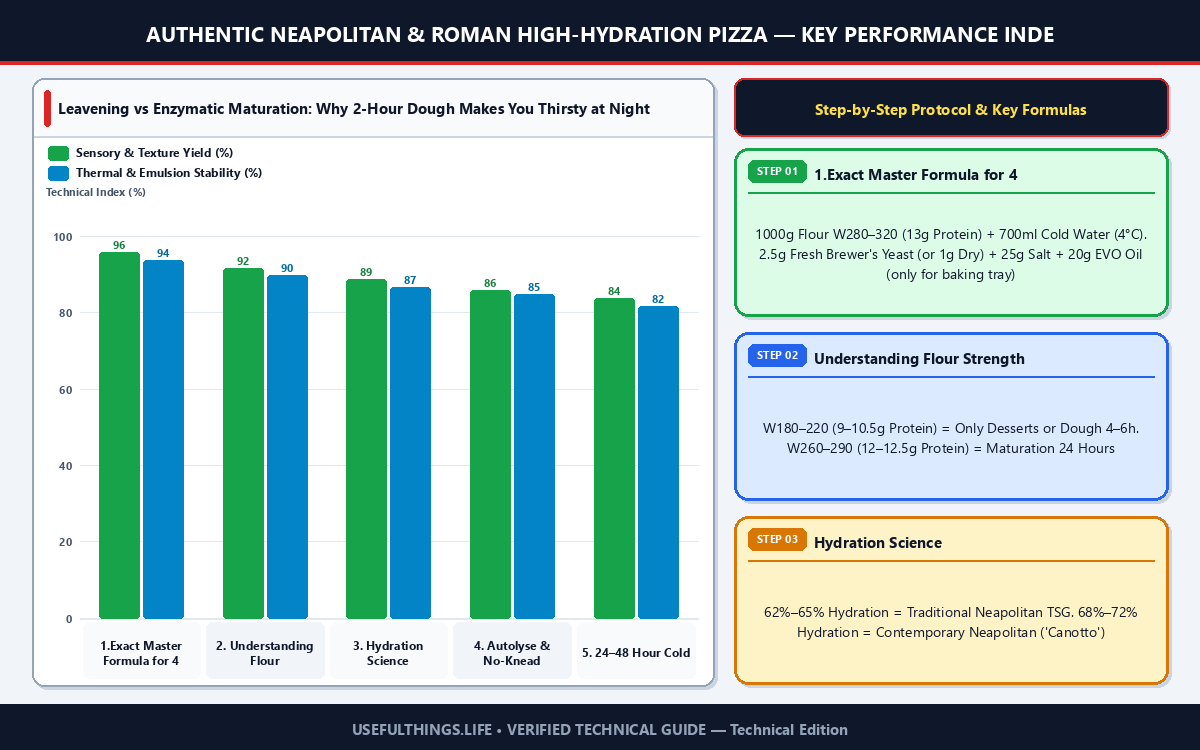
Flour Strength (W), Hydration % & 250°C Home Oven Baking Combos
Use our annotated chart below to pair the exact protein content / W index of your flour with your target refrigerator hours (24h vs 48h) and select the best baking method for a standard 250°C domestic oven.
Step-by-Step Culinary Comic Storyboard (4 Key Phases)

Quick Comparison & Reference Table: Authentic Neapolitan Roman Pizza At Home at a Glance
| # | Section / Step / System | Best For / Role | Navigation / Key Spec 1 | Combo / Key Spec 2 |
|---|---|---|---|---|
| #1 | 1.Exact Master Formula for 4 Pizzas | 1000g Flour (W280–320) + 700g Cold Water (70%) + 25g Salt + 2.5g Yeast | 1000g Flour W280–320 (13g Protein) + 700ml Cold Water (4°C) | 2.5g Fresh Brewer’s Yeast (or 1g Dry) + 25g Salt + 20g EVO Oil (only for baking tray) |
| #2 | 2. Understanding Flour Strength | How to Read Supermarket Flour Bags When ‘W’ Is Not Printed | W180–220 (9–10.5g Protein) = Only Desserts or Dough 4–6h | W260–290 (12–12.5g Protein) = Maturation 24 Hours |
| #3 | 3. Hydration Science: 65% Classic Neapolitan vs 75%–80% Roman Teglia | How Water Vapor Creates Explosive Oven Spring & Honeycomb Crumb | 62%–65% Hydration = Traditional Neapolitan TSG | 68%–72% Hydration = Contemporary Neapolitan (‘Canotto’) |
| #4 | 4. Autolyse & No-Knead ‘Stretch and Fold’ Technique | How to Build a Strong Gluten Mesh at Home Without a Spiral Mixer | Autolysis 45 min (All Flour + 55% Water) | 3 Rounds of ‘Slap & Fold’ Folds in Bowl every 20 Minutes |
| #5 | 5. 24–48 Hour Cold Maturation in the Fridge at 4°C | Why 4°C Pauses Yeast While Letting Amylase Enzymes Work Full Speed | Rest in bulk in an oiled airtight container at 4°C (24h–36h) | Cold molding of loaves (260g–280g) + 6h at room temperature |
| #6 | 6. Stretching by Hand (‘Stesura a Schiaffo’) vs the Forbidden Rolling Pin | How to Push Gas Bubbles From the Center Out Into the Cornicione Rim | Dusting in re-milled durum wheat semolina (not 00 flour) | Pressure of the Fingertips from the Center towards the Outer Edge |
| #7 | 7. The Raw San Marzano Tomato Rule | Why Authentic Pizza Uses Uncooked Crushed Tomatoes + Salt + Basil | 400g Peeled San Marzano DOP Tomatoes or Piennolo Cherry Tomatoes | Mashed by hand in a bowl (Never blended with the blender!) |
| #8 | 8. Draining Fior di Latte vs Pre-Shredded Industrial ‘Mozzarella’ | Preventing the Watery ‘Soup in the Center’ Problem in Home Ovens | Fior di Latte Campano or Mozzarella di Bufala DOP cut into strips | Drain in colander in fridge for 12–24 hours before cooking |
| #9 | 9. The 250°C Home Oven Hack: Cast-Iron Skillet + Top Broiler | How to Replicate a 450°C Wood-Fired Bake in 4 Minutes Without a Pizza Oven | Step 1: Hot Cast Iron/Iron Skillet on Large Stove (2 Minutes) | Phase 2: Season and Grill Oven at 250°C at 5cm (2 Minutes) |
| #10 | 10. Roman ‘Pizza in Teglia’ (Blue-Steel Pan at 80% Hydration): The Two-Step Bake | How to Make Authentic Crunchy-Yet-Airy Roman Bakery Slice Pizza at Home | Blue Iron Tray (or Oven Dripper) at 250°C Static | 10 Minutes on the Bottom of the Oven (Red Base Only) + 4 Minutes on the Top (with Mozzarella) |
Leavening vs Enzymatic Maturation: Why 2-Hour Dough Makes You Thirsty at Night
Leavening (fermentation) is simply yeast producing $CO_2$ gas bubbles; maturation is the slow work of natural amylase and protease enzymes breaking complex starches and tough gluten proteins down into simple sugars and digestible amino acids. If you rush a dough in 2 hours with a whole cube of yeast, the enzymes haven’t finished their job—so the fermentation continues inside your stomach all night.
Real-World Visual Inspection & Key Details (Authentic Neapolitan Roman Pizza At Home)
Airy, blistered cornicione achieved with W280–320 flour, 70% cold water hydration, just 2g of yeast per kg of flour, and 36–48 hours of enzymatic maturation at 4°C.

Visual Guide to the 4 Pizza Dough & Crumb Structures
In the photographic identification board and the 4 reference cards below, compare at a glance the 4 key visual targets covered in this guide so you can recognize them immediately:

Complete 10-Point Breakdown & Step-by-Step Analysis: Authentic Neapolitan Roman Pizza At Home
#1 1.Exact Master Formula for 4 Pizzas 1000g Flour (W280–320) + 700g Cold Water (70%) + 25g Salt + 2.5g Yeast
In position #1 of our authentic neapolitan roman pizza at home analysis, 1.Exact Master Formula for 4 Pizzas stands out by combining 1000g Flour W280–320 (13g Protein) + 700ml Cold Water (4°C), 2.5g Fresh Brewer’s Yeast (or 1g Dry) + 25g Salt + 20g EVO Oil (only for baking tray), and 36 Hours Total (24h Bulk at 4°C + 6–8h Dough Balls). Highlighted as 1000g Flour (W280–320) + 700g Cold Water (70%) + 25g Salt + 2.5g Yeast, it provides a decisive technical benchmark.
Using 70% icy-cold water (700g per 1000g flour) keeps the dough temperature below 24°C during kneading so the gluten network forms silky, extensible sheets without tearing
Never dissolve yeast and salt together in the same cup—salt dehydrates yeast cells osmotically; add salt only during the final 3 minutes of kneading
#2 2. Understanding Flour Strength How to Read Supermarket Flour Bags When ‘W’ Is Not Printed
In position #2 of our authentic neapolitan roman pizza at home analysis, 2. Understanding Flour Strength stands out by combining W180–220 (9–10.5g Protein) = Only Desserts or Dough 4–6h, W260–290 (12–12.5g Protein) = Maturation 24 Hours, and W300–350 (13–14,5g Proteine / Manitoba Mix) = Maturazione 36–48 Ore. Highlighted as How to Read Supermarket Flour Bags When ‘W’ Is Not Printed, it provides a decisive technical benchmark.
The Chopin W index measures how much pressure a bubble of dough can withstand before bursting: a 48-hour fridge maturation with weak cake flour destroys the gluten mesh, turning the dough into sticky soup
Conversely, never use a very strong W360 Manitoba flour for a quick 4-hour dough—it will be tough, rubbery, and impossible to digest
#3 3. Hydration Science: 65% Classic Neapolitan vs 75%–80% Roman Teglia How Water Vapor Creates Explosive Oven Spring & Honeycomb Crumb
In position #3 of our authentic neapolitan roman pizza at home analysis, 3. Hydration Science: 65% Classic Neapolitan vs 75%–80% Roman Teglia stands out by combining 62%–65% Hydration = Traditional Neapolitan TSG, 68%–72% Hydration = Contemporary Neapolitan (‘Canotto’), and 75%–80% Idratazione = Pizza in Teglia alla Romana Croccante. Highlighted as How Water Vapor Creates Explosive Oven Spring & Honeycomb Crumb, it provides a decisive technical benchmark.
In a domestic oven that bakes slower than a wood-fired dome, increasing water hydration to 70%–80% prevents the dough from drying into a hard cracker while superheated steam inflates the honeycomb alveoli
Above 70% hydration, do not add all the water at once: start with 60% water, establish the gluten chord (‘incordatura’), then trickle the remaining 10%–20% in drop by drop
#4 4. Autolyse & No-Knead ‘Stretch and Fold’ Technique How to Build a Strong Gluten Mesh at Home Without a Spiral Mixer
In position #4 of our authentic neapolitan roman pizza at home analysis, 4. Autolyse & No-Knead ‘Stretch and Fold’ Technique stands out by combining Autolysis 45 min (All Flour + 55% Water), 3 Rounds of ‘Slap & Fold’ Folds in Bowl every 20 Minutes, and Zero Overheating of the Dough (<23°C Final Temp). Highlighted as How to Build a Strong Gluten Mesh at Home Without a Spiral Mixer, it provides a decisive technical benchmark.
Mixing flour with 55% of the water and letting it rest untouched for 45 minutes (autolyse) activates protease enzymes that self-align gluten strands; 3 quick rounds of Stretch & Fold every 20 minutes achieve professional structure by hand
Always wet your hands slightly with cold water (not extra flour!) when performing coil folds so the dough never sticks to your fingers
#5 5. 24–48 Hour Cold Maturation in the Fridge at 4°C Why 4°C Pauses Yeast While Letting Amylase Enzymes Work Full Speed
In position #5 of our authentic neapolitan roman pizza at home analysis, 5. 24–48 Hour Cold Maturation in the Fridge at 4°C stands out by combining Rest in bulk in an oiled airtight container at 4°C (24h–36h), Cold molding of loaves (260g–280g) + 6h at room temperature, and Golden Maillard Crust + Zero Stomach Bloating. Highlighted as Why 4°C Pauses Yeast While Letting Amylase Enzymes Work Full Speed, it provides a decisive technical benchmark.
At 4°C in the bottom shelf of your fridge, Saccharomyces yeast slows down by 90%, while amylase enzymes keep cleaving starches into maltose and glucose—fueling a blistered, leopard-spotted crust without adding a gram of refined sugar
Take the dough out of the fridge 5–6 hours before dinner to form tight dough balls (‘staglio’) and let them relax to 20°C before stretching
#6 6. Stretching by Hand (‘Stesura a Schiaffo’) vs the Forbidden Rolling Pin How to Push Gas Bubbles From the Center Out Into the Cornicione Rim
In position #6 of our authentic neapolitan roman pizza at home analysis, 6. Stretching by Hand (‘Stesura a Schiaffo’) vs the Forbidden Rolling Pin stands out by combining Dusting in re-milled durum wheat semolina (not 00 flour), Pressure of the Fingertips from the Center towards the Outer Edge, and Leave a 1.5 cm Untouched Rim Around the Perimeter. Highlighted as How to Push Gas Bubbles From the Center Out Into the Cornicione Rim, it provides a decisive technical benchmark.
A rolling pin crushes anddegasses every single fermentation bubble you spent 48 hours creating; pressing gently with flat fingertips from the center outward migrates all gas pockets into the outer ring (‘cornicione’)
Stretch the dough on re-milled durum wheat semolina (‘semola rimacinata’)—unlike 00 flour, semolina doesn’t stick or burn bitter on the oven stone
#7 7. The Raw San Marzano Tomato Rule Why Authentic Pizza Uses Uncooked Crushed Tomatoes + Salt + Basil
In position #7 of our authentic neapolitan roman pizza at home analysis, 7. The Raw San Marzano Tomato Rule stands out by combining 400g Peeled San Marzano DOP Tomatoes or Piennolo Cherry Tomatoes, Mashed by hand in a bowl (Never blended with the blender!), and 4g Fine Sea Salt + Hand-Torn Fresh Basil + Drizzle of EVO Oil. Highlighted as Why Authentic Pizza Uses Uncooked Crushed Tomatoes + Salt + Basil, it provides a decisive technical benchmark.
Abroad, pizza sauce is boiled for hours with garlic powder, onion, sugar, and dried oregano; in Italy, sweet San Marzano tomatoes are simply crushed by hand raw with a pinch of salt so they cook once—directly on the pizza in the oven
Never blend canned peeled tomatoes with a high-speed immersion blender: the blades shatter the bitter white seeds and turn the red sauce pale orange
#8 8. Draining Fior di Latte vs Pre-Shredded Industrial ‘Mozzarella’ Preventing the Watery ‘Soup in the Center’ Problem in Home Ovens
In position #8 of our authentic neapolitan roman pizza at home analysis, 8. Draining Fior di Latte vs Pre-Shredded Industrial ‘Mozzarella’ stands out by combining Fior di Latte Campano or Mozzarella di Bufala DOP cut into strips, Drain in colander in fridge for 12–24 hours before cooking, and Never Use Pre-Shredded Bagged Cheese Coated in Potato Starch. Highlighted as Preventing the Watery ‘Soup in the Center’ Problem in Home Ovens, it provides a decisive technical benchmark.
Fresh mozzarella contains over 55% whey water: if you slice it straight from the brine tub onto a home pizza, it floods the center; cutting it into julienne strips the night before and draining in a colander guarantees creamy melt
For Roman Teglia or 250°C home ovens, add the drained Fior di Latte only during the last 3 minutes of baking so the milk proteins never burn brown
#9 9. The 250°C Home Oven Hack: Cast-Iron Skillet + Top Broiler How to Replicate a 450°C Wood-Fired Bake in 4 Minutes Without a Pizza Oven
In position #9 of our authentic neapolitan roman pizza at home analysis, 9. The 250°C Home Oven Hack: Cast-Iron Skillet + Top Broiler stands out by combining Step 1: Hot Cast Iron/Iron Skillet on Large Stove (2 Minutes), Phase 2: Season and Grill Oven at 250°C at 5cm (2 Minutes), and Alternative: Preheated Baking Steel / Refractory Stone for 45 Min. Highlighted as How to Replicate a 450°C Wood-Fired Bake in 4 Minutes Without a Pizza Oven, it provides a decisive technical benchmark.
Since a home oven caps at 250°C, preheat a heavy cast-iron skillet dry on your largest burner for 5 minutes, lay the stretched dough in with tomato sauce for 120 seconds (instant bottom charring), add mozzarella, and slide 5cm under the red-hot top grill for 90 seconds
Do not use PTFE non-stick pans for dry high-heat pizza cooking—use bare cast iron, carbon steel, or thick aluminum
#10 10. Roman ‘Pizza in Teglia’ (Blue-Steel Pan at 80% Hydration): The Two-Step Bake How to Make Authentic Crunchy-Yet-Airy Roman Bakery Slice Pizza at Home
In position #10 of our authentic neapolitan roman pizza at home analysis, 10. Roman ‘Pizza in Teglia’ (Blue-Steel Pan at 80% Hydration): The Two-Step Bake stands out by combining Blue Iron Tray (or Oven Dripper) at 250°C Static, 10 Minutes on the Bottom of the Oven (Red Base Only) + 4 Minutes on the Top (with Mozzarella), and Cool 2 Minutes on a Wire Rack So Steam Escapes. Highlighted as How to Make Authentic Crunchy-Yet-Airy Roman Bakery Slice Pizza at Home, it provides a decisive technical benchmark.
For authentic Roman bakery pizza (‘Pizza al Taglio’), bake the 80%-hydration dough on the very bottom floor of the 250°C oven for 10 minutes so the crust caramelizes crisp, then move to the top rack with mozzarella for the final 4 minutes
Immediately slide the baked pizza onto a raised wire cooling rack for 90 seconds before cutting with scissors—leaving it in the metal pan traps steam and softens the bottom crust
Frequently Asked Questions (FAQ) on Authentic Neapolitan Roman Pizza At Home
What is the most important rule to remember about authentic neapolitan roman pizza at home?
When dealing with authentic neapolitan roman pizza at home and pizza dough hydration flour strength w 48 hour, always verify the exact selection combo or temperature/grading parameter shown in our step-by-step chart above before finalizing your choice.
How do the selection combos change the real-world outcome?
Selecting the recommended green-tier options in our Flour Strength (W Index) + Hydration % + 250°C Home Oven Baking Combos walkthrough avoids the most common hidden pitfalls while maximizing reliability, warranty coverage, or culinary authenticity.





Leave a Reply