


Why do some people claim 'I just don't have a hat face'? Because they pull hats straight down to their eyebrows! The 3 golden laws of hat visagism: 1) Round faces need tall, pinched angular crowns (Fedora, Trilby, Cuff Beanie worn high) tilted at a 15° diagonal angle; 2) Square faces need curved crowns and soft brims (Beret, Floppy Sun Hat, Cloche, Slouchy Beanie); 3) Long:Oblong faces need low flat crowns (Boater, Bucket Hat, Wide-Brim Panama) worn straight across mid-forehead.
A hat sits directly on top of your upper facial third—meaning it has the power to elongate a round face by 3 inches, shorten a long forehead by half, or soften an angular jaw. Even a simple winter knit beanie or a weekend baseball cap looks completely different when you shift it 2 centimeters back on your hairline and let two face-framing strands peek out. Use our Headwear Visagism Calculator below.
🪞 Hats, Beanies, Berets & Baseball Caps Calculator by Face Shape
LIVE VISAGISM ADVISOR
Select your face shape and headwear category to unlock your ideal crown height, brim width, and tilt angle.
–
4-Step Photographic Guide — Hats, Beanies, Berets & Baseball Caps for Your Face Shape
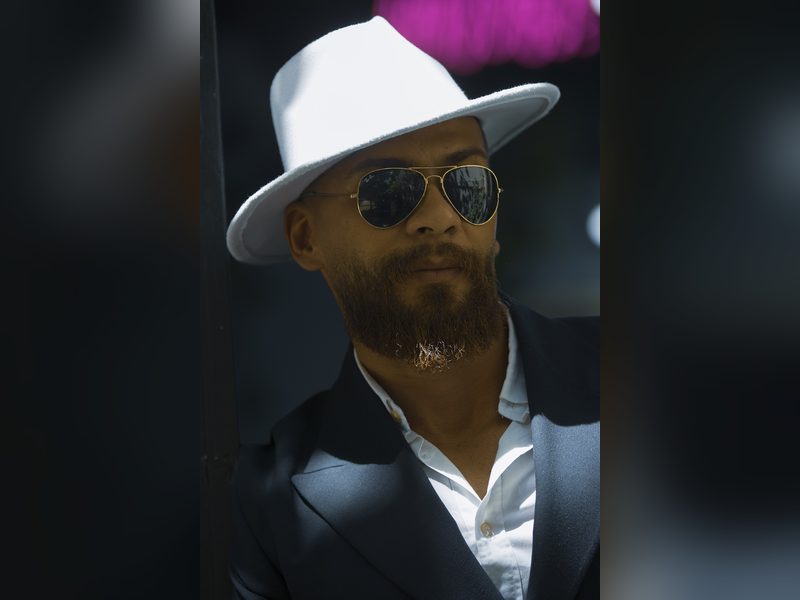 Photo: Mostafameraji · CC0 · Wikimedia Commons
 Photo: Dick Thomas Johnson from Tokyo, Japan · CC BY 2.0 · Wikimedia Commons
 Photo: Igor Gorshkov · CC BY 2.0 · Wikimedia Commons
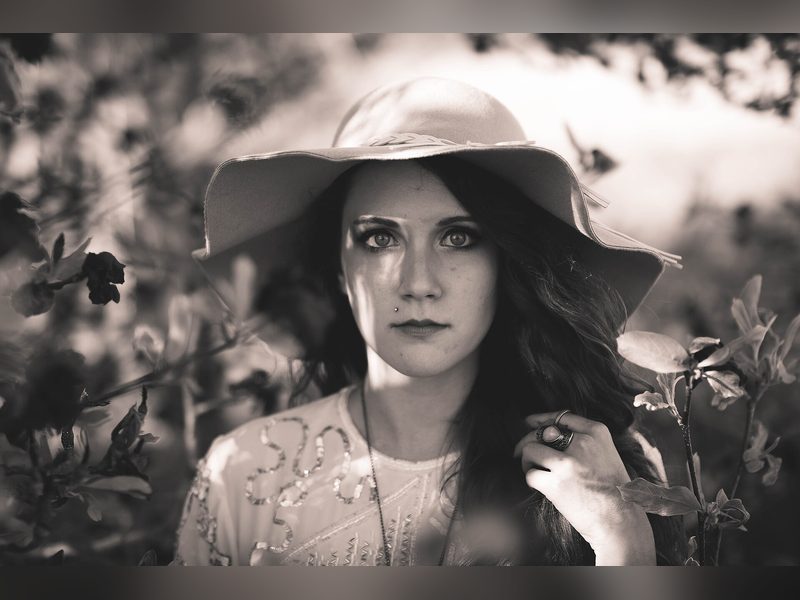 Photo: Rachael Crowe _rachaelcrowe · CC0 · Wikimedia Commons
4-Panel Visagist Comic: Proportions & Optical Illusions

Comparative Chart & Technical Table — Hats, Beanies, Berets & Baseball Caps for Your Face Shape
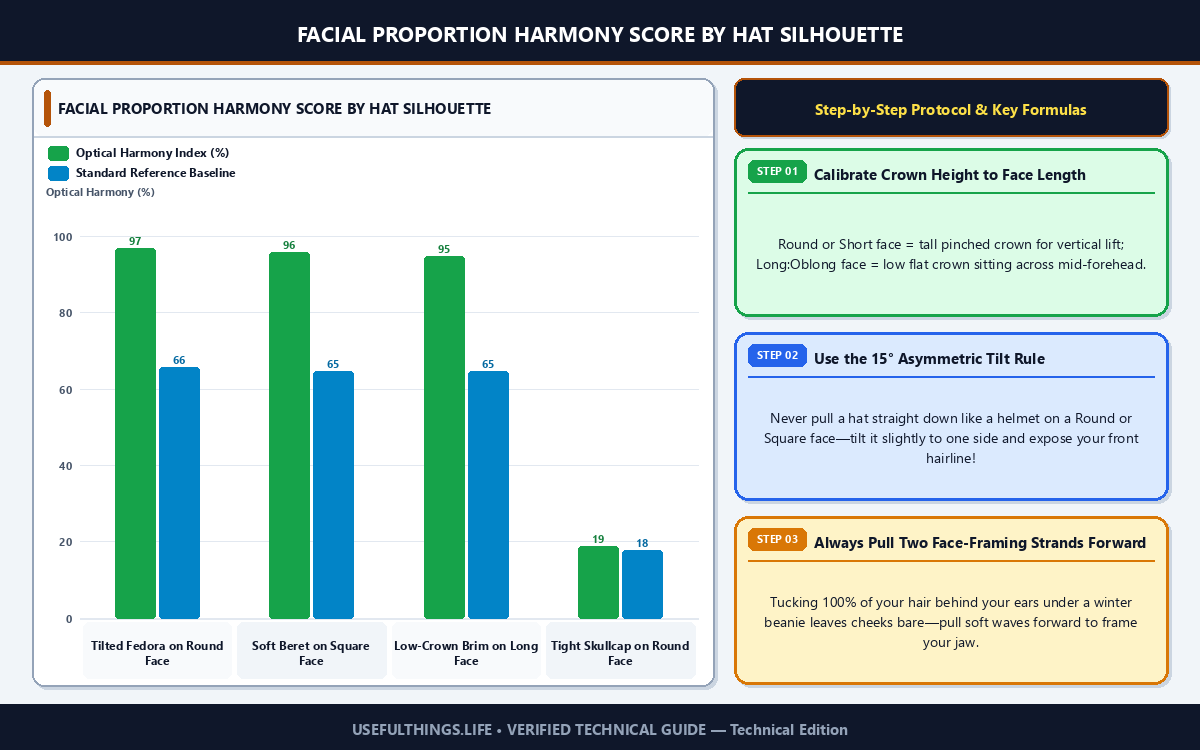
| Face Shape | Best Sun • Dress Hat | Best Winter Knit • Felt Hat | Best Baseball Cap Cut | Forehead Placement Rule |
|---|---|---|---|---|
| Round Face | Pinched-Crown Fedora • Medium Panama | Tall Cuffed Beanie (or Pom-Pom) • Angled Beret | Structured high-crown cap, moderate curve | Pushed back to expose hairline + 15° diagonal tilt |
| Square Face | Soft Floppy Brim • Rounded Cloche | Soft Wool French Beret • Slouchy Cashmere Beanie | Unstructured curved-bill 'Dad Cap' | Softly angled with loose waves framing the jawline |
| Heart • Diamond | Medium-Brim Panama • Bucket Hat | Baker Boy (Newsboy) • Ribbed Cuffed Beanie | Classic mid-profile cap with low loose waves | Resting at upper forehead with chin-level hair volume |
| Oblong • Long | Flat-Crown Boater • Wide-Brim Sun Hat | Fitted Cuffed Beanie worn low (no tall pom-pom) | Low-profile cap pulled down near the eyebrows | Worn level across mid-forehead to shorten upper third |
| Petite (< 5'4") | Compact Trilby • Short-to-Medium Brim | Beret or Cuffed Beanie (adds vertical height!) | Sleek fitted cap | Keep brim narrower than shoulders |
Morphological Analysis, Golden Rules & Optical Myths to Avoid
1. How to Style a French Beret Like a Parisian (The Hairline & 15° Slant Trick)
PARISIAN STYLING
Optical & Morphological Rule: Pulling a beret straight down over your forehead like a chef's hat flattens your features.
Follow the 3-step Parisian rule: 1) Place the inner band 1 inch behind your front hairline (or right behind your bangs); 2) Drape the soft wool crown asymmetrically toward one side at a 15° angle so one ear is slightly more covered than the other; 3) Leave loose waves or curtain bangs out around your cheekbones!
To keep a tilted beret secure all day in the wind, sew two tiny snap wig-clips inside the front headband.
2. Baseball Cap Visagism: Bill Curve & Ponytail Placement by Face Shape
CAP GEOMETRY
Optical & Morphological Rule: A baseball cap can either widen your cheeks or sculpt your cheekbones depending on bill curvature and hair placement.
1) Curve the bill gently to narrow wide temples (flat straight bills widen the face horizontally!); 2) Round:Oval faces: pull a high ponytail through the back keyhole slot to create an upward diagonal lift; 3) Square:Heart faces: wear hair down in loose waves or a low loose side braid with two front tendrils pulled forward in front of the ears!
Adding small gold hoop or stud earrings instantly elevates a casual baseball cap into an intentional street-style look.
3. The 'Flipped-Part' Trick to Prevent Winter Hat Hair & Static Frizz
ANTI-FLAT HAIR HACK
Optical & Morphological Rule: Do you avoid winter beanies because they crush your root volume and cause static electricity?
Use the backstage stylist trick: before putting on your beanie, flip your hair part to the OPPOSITE side of where you normally wear it! When you arrive indoors, take off the hat, and flip your hair back to your normal side, your roots will stand up with instant bouncy volume! Also choose satin-lined or 100% cashmere:merino beanies instead of static-inducing acrylic.
Never put a hat on while your hair is still warm from blow-drying—let hair cool 100% first so the hydrogen bonds lock in your volume!
4. The Myth That 'Only Long-Haired Women Look Good in Hats'
❌ STYLING MYTH • MISTAKE
Optical & Morphological Rule: Women with Bobs or Pixie cuts often worry that wearing a beanie or fedora will hide all their hair.
Chin-length Bobs and textured Pixies actually look extraordinary in hats—because the bottom of a Bob hits right below the hat brim without bulk at the neck! Simply wear the hat slightly tilted back so your front fringe or side-swept bangs peek out in front.
Pair short hair + a hat with luminous stud or huggie earrings at the earlobe to frame your cheekbones.
 Photo: Tom Woodward · CC BY-SA 2.0 | Menswear Market · CC BY 2.0 · Wikimedia Commons
Frequently Asked Questions (FAQ)
❓ How do I measure my head for my exact hat size in centimeters and inches?
Wrap a soft tailor's tape around your head 0.5 inch (1 cm) above your ears and across the center of your forehead: 54–55 cm (21.2–21.6 in) = Small, 56–57 cm (22–22.4 in) = Medium (standard women's size), 58–59 cm (22.8–23.2 in) = Large.
❓ What if a structured Fedora or sun hat is half a size too big?
Apply adhesive foam hat-sizing tape underneath the interior sweatband at the front and back—it invisibly snugs the fit by 0.5–1 cm and keeps the hat secure in a breeze.
❓ Which winter beanie color brightens a pale winter complexion best?
Instead of stark black or murky charcoal, choose Warm Cream, Camel, Cinnamon, or Olive for Warm undertones, and Rich Burgundy, Navy, Soft Lavender-Grey, or Dusty Rose for Cool undertones!
❓ How do I wear eyeglasses or sunglasses with a hat without looking crowded?
Keep at least 0.75 inch (2 cm) of bare forehead skin visible between the top rim of your glasses and the bottom edge of your hat so the two frames don't collide.
🔗 Related Technical Guides & Calculators
- Espresso Martini, Authentic Irish Coffee & White Russian: Foam Science
- Natural Health & Daily Wellness Remedies
- Everyday Home Tips & Eco Cleaning Guides
📚 Scientific Sources, Anthropometry & References
- Journal of Investigative Dermatology — Facial Anthropometry & Optical Symmetry Studies
- International Journal of Cosmetic Science — Colorimetry, Hair Fiber Optics & Visagism
- American Academy of Dermatology (AAD) — Clinical Skin Barrier & Hair Morphology Guidelines








Leave a Reply